
Smartwatch Activity Face
A smartwatch face on pure black wakes from always-on: seconds tick, rose, amber and periwinkle activity rings fill and close one by one with a single ripple each, a heart-rate trend scrolls as the pulse eases, then the face dims back to rest.
Written and rendered by AI CSS Animations Oct 16, 2026
- Type
- prompt
- Made with
- Claude Opus 5.5 in Claude Code
- Built in
- Canvas
- Topics
- Phone · Charts
About this style
Smartwatch faces are designed for small OLED screens, where black pixels are switched off, so designers treat pure black as the canvas and let saturated color carry the information. Rings that fill toward daily goals, small complications for the date, weather and battery, and a live heart-rate readout became the standard vocabulary of fitness wearables. The style favors legibility at a glance, with big numerals and motion that is brief and purposeful.
The prompt
Make a 10-second smartwatch face animation on true black: the face wakes, complications tick, three activity rings close and a heart-rate trace runs.

<inputs>
If I don't give you something, use the default and don't ask.
- Watch: Bracken, face "Ridge"
- 6:47, seconds from :20; WED 21; 14°, cloudy; battery 82%
- Rings: Energy 402 → 540 of 540 kcal; Workout 18 → 30 of 30 min; Steps 6,240 → 8,000 of 8,000
- Heart rate: 134 easing to 112 bpm
- Length: 10 seconds
</inputs>

<direction>
Black is the canvas: stage and face #000000, OLED style. Rings: Energy #FF4F6D, Workout #FFB020, Steps #7B8CFF, each over an 18% track of its hue; text #FFFFFF, secondary #9A9A9A. Avoid the familiar red, green and cyan trio.
The face: a 700×860 display with 150px corners, centered, its edge a faint 1px hairline.
Type: Sofia Sans Extra Condensed 700 for the time (230px) and seconds (64px); Sofia Sans Condensed for values (34–44px) and 22px uppercase labels. Changing digits sit in fixed-width cells.
Layout, 60px padding: on top, the time with seconds beside it, a battery arc, the date ("WED" in rose over "21") and the weather. Middle: three concentric rings (outer radius 170, 40px wide, 6px gaps, round caps) beside readouts in ring colors ("402" over "/540 KCAL"). Bottom: a 580×120 heart panel: a drawn heart, the bpm, and the last minute of readings as a rose line with a 15% fill, scrolling left.
Rings fill clockwise from 12 o'clock, each leading cap casting a soft shadow. A close lands exactly on 100%: "DONE" appears and one thin ring of its color ripples 30px outward and fades, once.
Ticks: seconds roll once a second; values count with their ring, never spinning; the bpm updates every 0.8s; the heart pulses at the current rate in scale only, never in brightness.
Always-on: the piece starts and ends at 45% brightness, seconds and trace hidden; waking is a 0.4s brightness ramp with a 2% scale-up, like a raised wrist.
Motion is brief and exact: UI changes 120–300ms on cubic-bezier(0.2, 0.8, 0.2, 1); ring fills 1.2s on cubic-bezier(0.3, 0, 0.2, 1).
Premium is a face read at a glance: big numerals, saturated color on true black. Cheap is neon glow, a grey watch body and spinning numbers.
Banned: any background but #000000, gradients, glows over 20%, a drawn watch case or strap, ECG spikes, emoji, anything flashing more than 3 times per second.
</direction>

<structure>
0.0–0.8s: always-on: "6:47" without seconds, rings resting at 74%, 60% and 78%.
0.8–1.2s: wake; seconds appear at :20; the heart panel fades in and its trace starts moving.
1.2–2.4s: complications settle: the battery arc draws to 82%, the cloud draws, the date steps in.
2.4–3.6s: Energy fills to 540 and closes with its ripple.
3.2–4.4s: Workout fills to 30 and closes.
4.0–5.2s: Steps fill to 8,000 and close.
5.2–8.2s: the pulse eases toward 112; the trace scrolls; seconds tick; a slow 3% push.
8.2–8.7s: wrist down: back to always-on.
8.7–10.0s: hold, perfectly still.
For other lengths, stretch the 5.2–8.2s passage and keep at least 1s of hold.
</structure>

<build>
One self-contained index.html, CSS and JS inline; Google Fonts via <link>, awaited with document.fonts.load() before window.seek is defined; no other libraries. Draw on one Canvas 2D at devicePixelRatio, repainting each frame from scratch. The stage is 1920×1080 (16:9), scaled to fit the window; design for 60fps. window.seek(t), t in seconds, must compute every visual from t alone: no CSS transitions or animations, no setTimeout or setInterval, no state carried between frames, randomness only from a seeded PRNG. Precompute a seeded heart-rate series (two samples a second, ±3 bpm wander) once at load. Without ?render in the URL, drive seek from requestAnimationFrame (loop after a 1s end hold); with ?render, don't start that loop.
</build>

<check>
Before showing me, step through one frame per second: screenshot each and look at it. Fix overlaps, clipped or cramped text and anything off-style or Banned. Check everything outside the content is pure #000000, each ring matches its readout (402 of 540 is 74%), rings close at exactly 100%, and nothing pulses in brightness. Confirm seek(10) and seek(11) match, so the final frame holds.
</check>
Ours, and free to use under CC0: copy it, change it, ship it. No credit needed.
Similar prompts
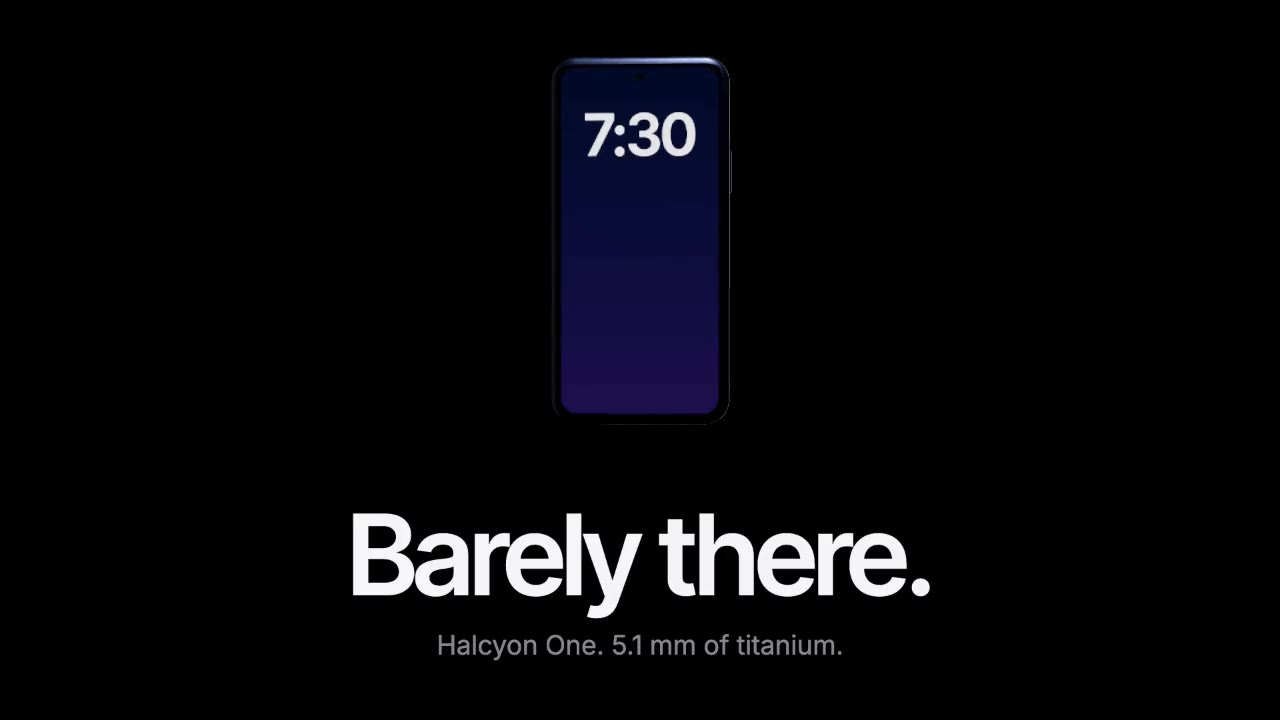
A device built in three.js rises out of total darkness while a softbox reflection glides along its titanium edge, then…
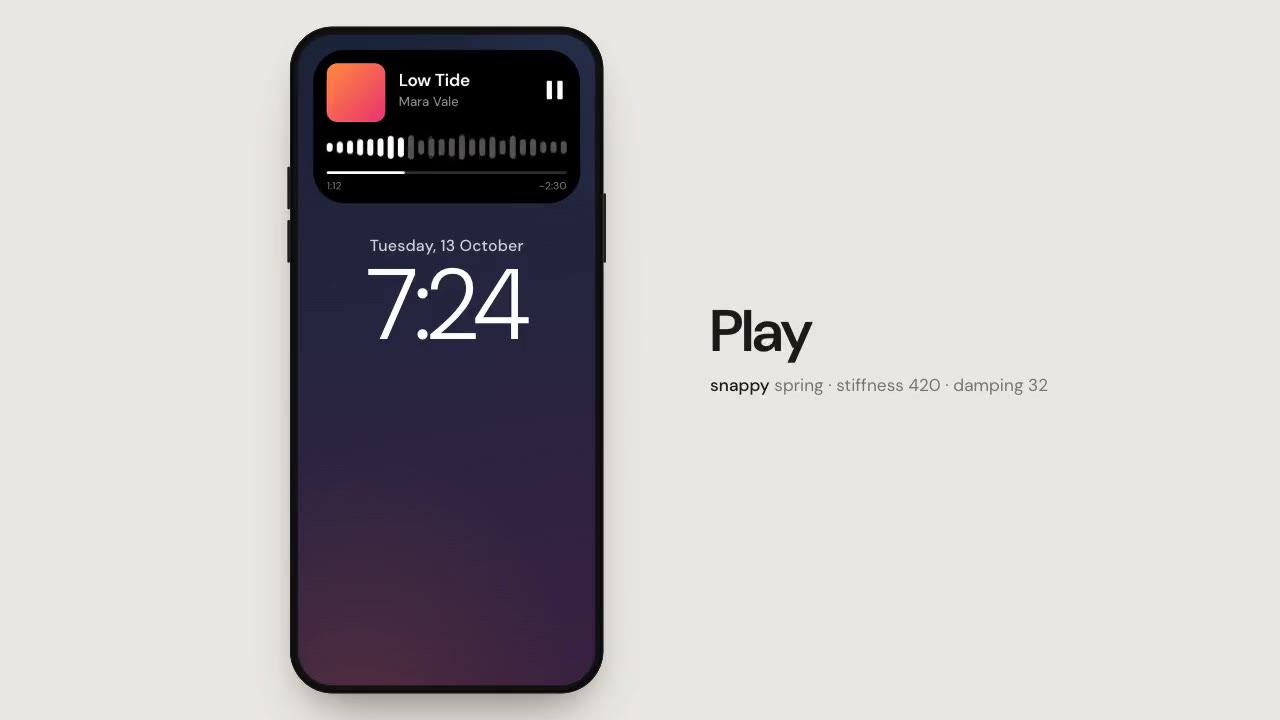
One black pill on a phone screen morphs into a notification, a live card and a music player on closed-form springs that…
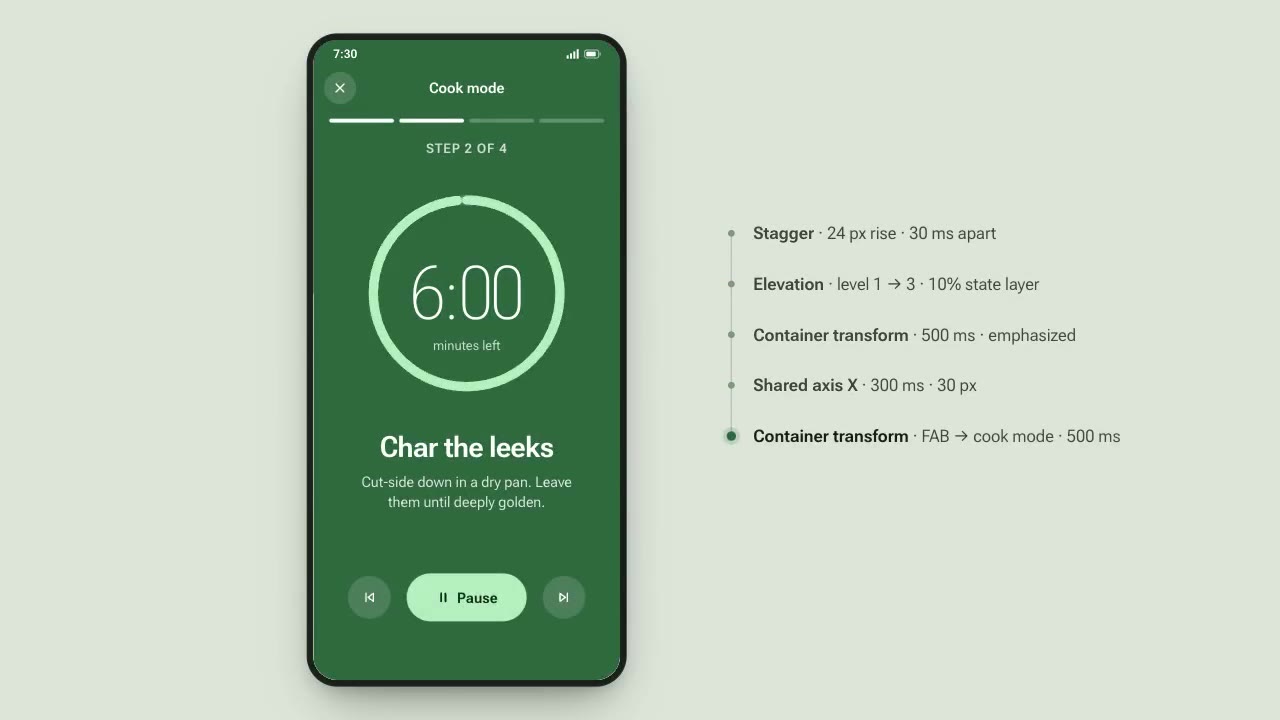
A recipe app demonstrates Material-style motion: a card expands into a full screen, tabs switch on a shared axis, a FAB…
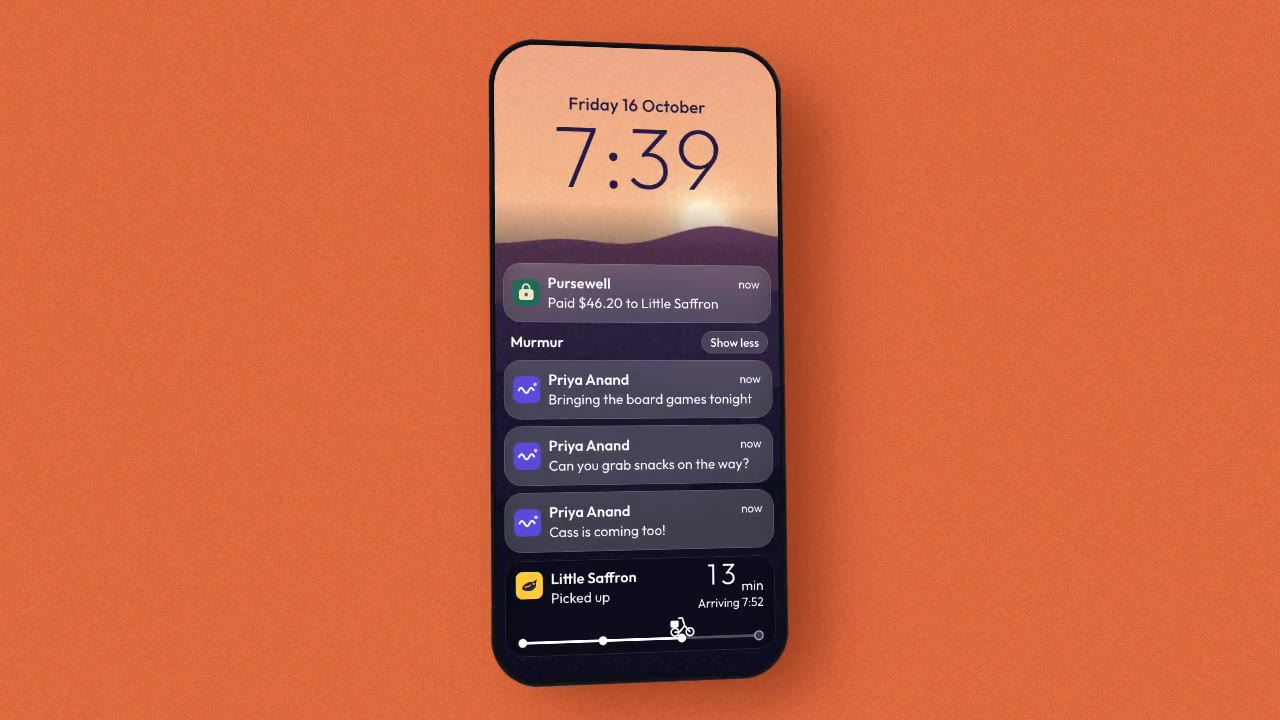
A phone on a terracotta stage wakes to a dusk-hills wallpaper: frosted notifications spring up and push each other, thr…
More like this on the motion design inspiration board: Data visualization inspirationApp animation inspiration