
Ride-Hailing App
A night map seen through a phone that works like a lens, the city dimmed around it: a coral route draws along procedural streets, a car follows it, slowing at each turn and crossing a bridge, the ETA rolls down and the driver card slides up.
Written and rendered by AI CSS Animations Oct 16, 2026
- Type
- prompt
- Made with
- Claude Opus 5.5 in Claude Code
- Built in
- SVG
- Topics
- Phone · Maps
About this style
Ride-hailing apps made the live map the main interface: riders watch the route draw along the streets, a car move toward them and the arrival time count down. The visual language pairs a quiet basemap and one bright route color with a bottom sheet that slides up to show the driver, vehicle and plate. Delivery, logistics and mobility products reuse this map-and-sheet pattern whenever something is on its way to the user.
The prompt
Make a 10-second ride-hailing app demo: on a night map the route draws along the streets, a car follows it to the pickup, the ETA counts down and the driver card slides up.

<inputs>
If I don't give you something, use the default and don't ask.
- App: Pillion. Pickup: Alder Street & Rook Lane. Destination: Gallery Quay
- Driver: Tomas R., 4.92, grey hatchback, plate KLV 482
- ETA: 6 min, down to "Arriving"
- Route color: #FF5C7A. Length: 10 seconds
</inputs>

<direction>
The map is fictional and procedural: a street grid rotated −12° with seeded 150–210px blocks, an avenue crossing it at 33°, a river with two bridges, a park ("Fenwick Green") and building footprints. Four streets are labelled, Alder Street and Rook Lane among them.
Night palette: land #0E1422, blocks #131B2C, streets #243049 and #33405E, avenue #3D4C70, river #0B2238, park #10302A, labels #6F7C9B. The route is 8px over a dark casing, fading to 25% behind the car. Car: a top-down white hatchback, 24×46px. Pin: a route-colored disc with one slow halo every 1.6s.
The phone is a lens: a 450×940 phone centered on stage, and the same map at the same transform fills the whole stage, dimmed and desaturated outside the phone and full strength inside, so the phone reads as a window onto a bigger city.
Route: streets only, four right-angle turns, one leg along the avenue over a bridge, corners filleted at 28px. The car slows to 45% near each corner, arrives at 8.2s and always points along the path.
ETA = ceil(6 × remaining ÷ total length) min, in a chip above the pin and in the sheet, rolling when it changes; "Arriving" for the last 6%.
Camera: an overview at scale 0.55, then easing to 1.0 on a point ahead of the car, averaged over its previous 0.5s so it trails without stored state; north stays up.
Phone UI: a top pill with "Gallery Quay"; a dark bottom sheet that starts 150px tall ("Pickup in 6 min") and slides up to 330px into the driver card: avatar, "Tomas R.", "★ 4.92", "Grey hatchback", the plate in an outlined box, "Message" and "Call".
Type: Golos Text 400–700; street labels 20px uppercase along their streets; sheet text 22–26px, ETA 44px.
Motion: the route draws by dash offset over 1.2s on cubic-bezier(0.45, 0, 0.2, 1); sheet and pin ride springs (stiffness 240, damping 26); UI fades take 0.3s on cubic-bezier(0.22, 1, 0.36, 1).
Premium is a city you believe and a car that drives it: turns that slow, a camera that trails. Cheap is a car icon sliding diagonally over a grey grid.
Banned: real map data or cities, map libraries, real ride-hailing looks, teardrop pins, 3D tilt, a car cutting across blocks, emoji, anything flashing more than 3 times per second.
</direction>

<structure>
0.0–1.0s: the map fades up, inside the phone first, then the dimmed surround; the top pill and small sheet rise.
1.0–1.6s: the pin drops on a spring and its halo starts; the car appears.
1.6–2.8s: the route draws from car to pin over the overview.
2.8–3.8s: the camera eases in to follow as the car pulls away.
3.8–6.6s: the car drives, slowing through turns and crossing the bridge; the ETA rolls down.
6.6–7.4s: the sheet slides up into the driver card.
7.4–8.2s: the car takes its last corner and stops beside the pin: "Arriving".
8.2–8.8s: the halo stops; the camera comes to rest.
8.8–10.0s: hold.
For other lengths, stretch the drive and keep at least 1s of hold; the car always arrives before it.
</structure>

<build>
One self-contained index.html, CSS and JS inline; Google Fonts via <link>, awaited with document.fonts.load() before window.seek is defined; no other libraries. Draw the map, route, pin and car in one inline SVG, the map built once into a <g> used twice (dimmed outside, clipped to the screen inside); the phone UI is HTML/CSS on top. The stage is 1920×1080 (16:9), scaled to fit the window; design for 60fps. window.seek(t), t in seconds, must compute every visual from t alone: no CSS transitions or animations, no setTimeout or setInterval, no state carried between frames, randomness only from a seeded PRNG. Precompute the car's distance-by-time table once at load at a 1/240s step. Without ?render in the URL, drive seek from requestAnimationFrame (loop after a 1s end hold); with ?render, don't start that loop.
</build>

<check>
Before showing me, step through one frame per second: screenshot each and look at it. Fix overlaps, clipped or cramped text and anything off-style or Banned. Check the car stays on its street and points along it, the route crosses water only on a bridge, the two map layers align at the phone's edge, and the ETA only falls. Confirm seek(10) and seek(11) match, so the final frame holds.
</check>
Ours, and free to use under CC0: copy it, change it, ship it. No credit needed.
Similar prompts
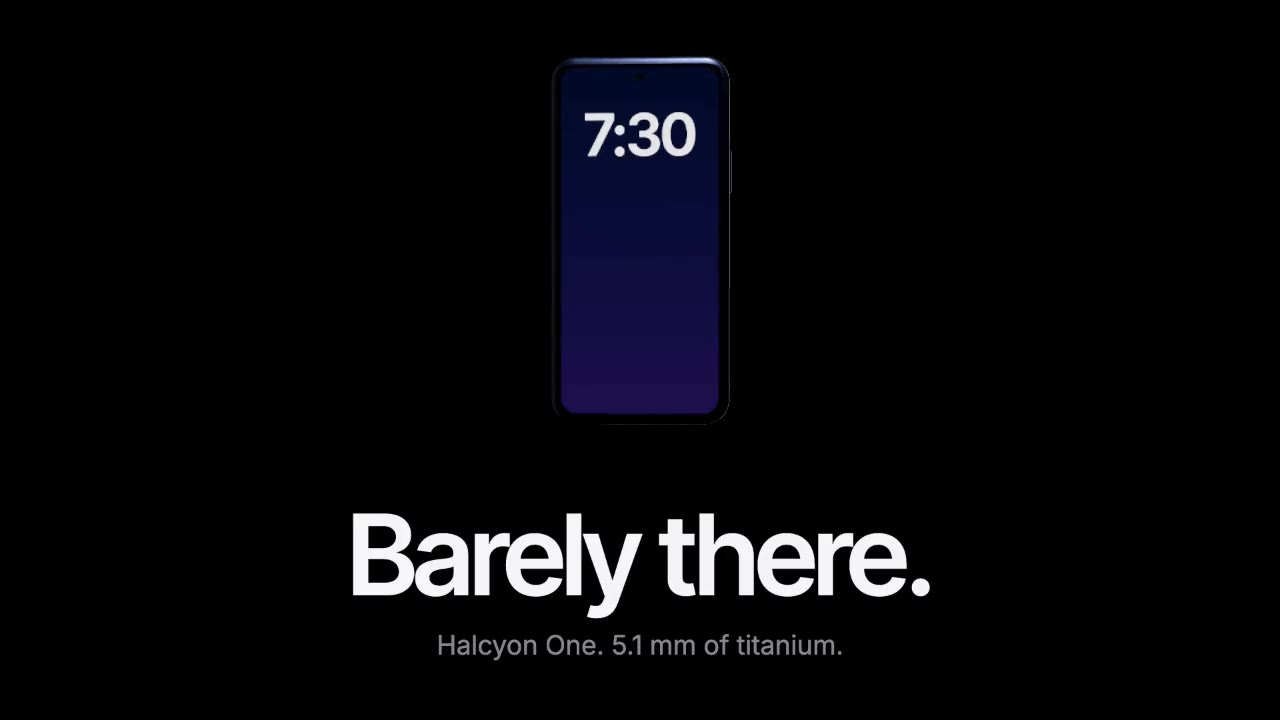
A device built in three.js rises out of total darkness while a softbox reflection glides along its titanium edge, then…
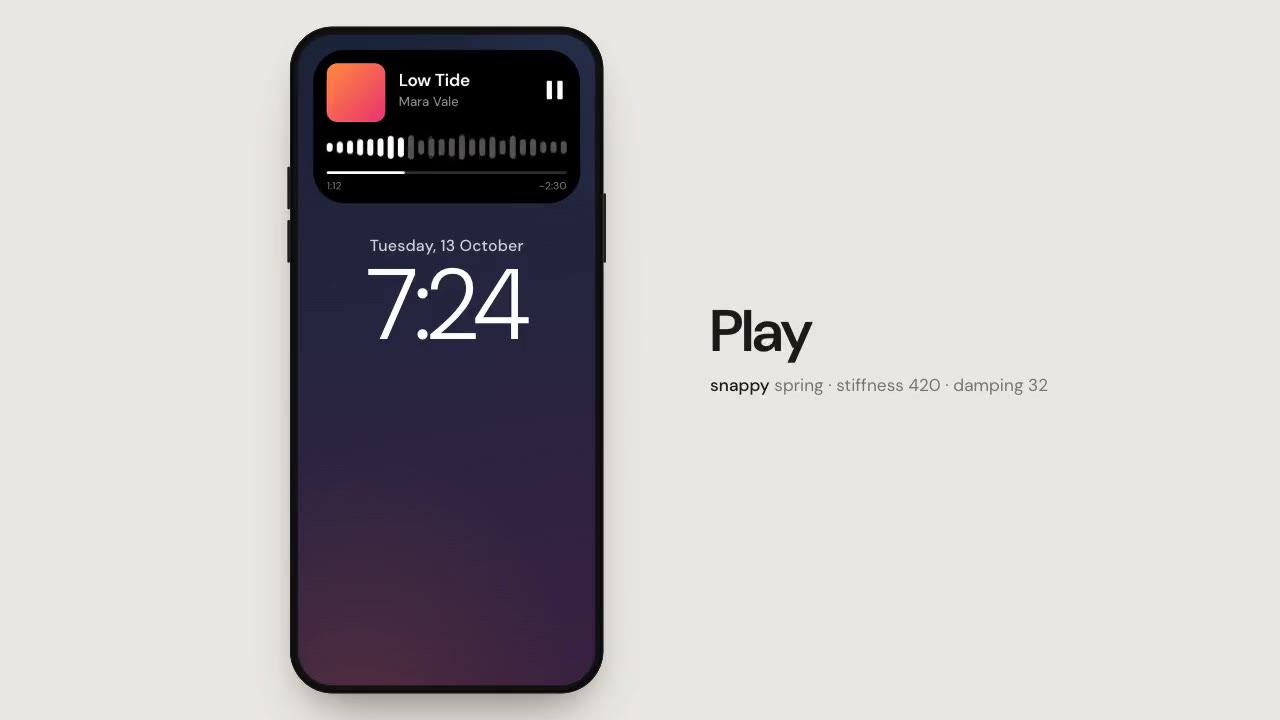
One black pill on a phone screen morphs into a notification, a live card and a music player on closed-form springs that…
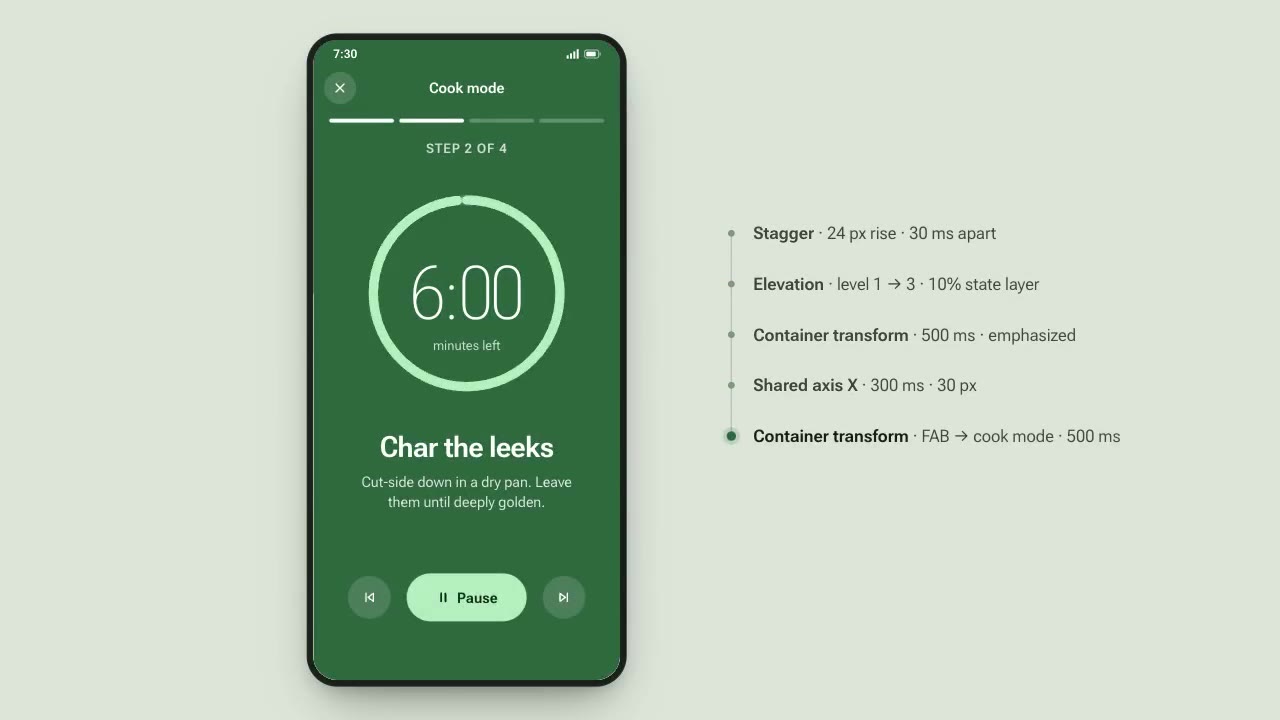
A recipe app demonstrates Material-style motion: a card expands into a full screen, tabs switch on a shared axis, a FAB…
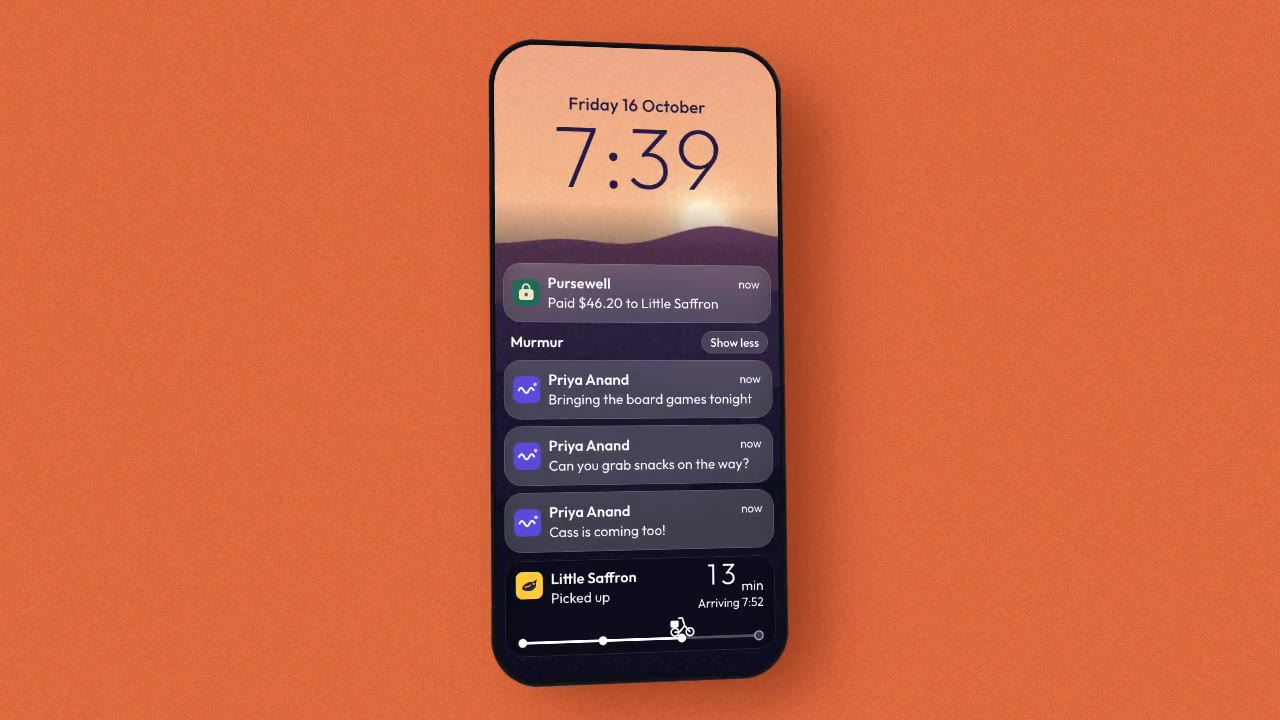
A phone on a terracotta stage wakes to a dusk-hills wallpaper: frosted notifications spring up and push each other, thr…
More like this on the motion design inspiration board: App animation inspirationMap animation inspiration