
Isometric Hairline
A tidy isometric line-art explainer: constant 2px strokes, white faces and one vermilion accent as a parcel travels from warehouse to doorstep on a 30° grid, each object extruding into place.
Written and rendered by AI CSS Animations Oct 12, 2026
- Type
- prompt
- Made with
- Claude Opus 5.5 in Claude Code
- Built in
- SVG
- Topics
- Line art · Explainer
About this style
Isometric projection draws the three axes at equal angles, so objects keep their true proportions with no vanishing point; it has long been used in technical drawing, games and infographics. The hairline variant strips it to one constant stroke, white faces and a single accent color. Teams use it for product explainers and onboarding because it reads as precise, calm and systematic, and it scales from a single icon to a whole scene.
The prompt
<inputs>
You're making a short isometric line-art explainer. I may supply any of these; if I don't give you something, use the default and don't ask.
- Subject: "From order to doorstep" for Parcelwing, a fictional courier.
- Stations: warehouse shelves → conveyor → van → front door.
- Title: "Order to doorstep".
- Accent color: #FF4F2E.
- Length: 10 seconds.
</inputs>

<direction>
Ground #F6F5F1, ink #1C1D21, every face filled #FFFFFF and drawn back to front so near objects hide far lines. The accent fills only the hero object (the parcel) and the route dashes, under 8% of the frame. A dot grid (1.5px, #D6D5D0) marks the floor.
True isometric with unit u = 28px: screenX = (x−y)·cos30°·u, screenY = (x+y)·sin30°·u − z·u. Every edge follows one of the three axes; footprints snap to half units; no perspective.
One stroke: 2px, round caps and joins, non-scaling, so a pencil and a building share the same line. Detail means more lines, never heavier ones. Figures are 1.6 units tall: capsule body, circle head, no face.
Type: "IBM Plex Sans" 600 for the title (56px); "IBM Plex Mono" 500 for labels (18px, uppercase, tracking 0.08em), upright, on a horizontal hairline leader ending in a 5px dot.
Motion: parts assemble. A footprint draws on (0.3s, easeOutQuad), walls extrude up from z=0 (0.5–0.7s, easeOutCubic), then inner lines draw. Siblings stagger 80–120ms. Drops use easeOutBack with ≤4% overshoot. Movers travel only along grid axes, easeInOutSine per leg, turning at right angles. Figures bob between two poses at 4 steps per second. The camera is locked apart from a 3% push across the whole piece.
Authentic: generous white space, a weight that never changes, the accent used like a highlighter. Cheap: depth faked with gray fills, objects drifting off-axis.
Banned: gradients, shadows, gray fills, vanishing points, mixed stroke weights, a second accent, emoji, icon libraries.
</direction>

<structure>
- 0–0.8s: grid dots ripple in from the center; the title draws on top-left.
- 0.8–2.6s: warehouse slab and shelves extrude; a figure pops in holding the accent parcel.
- 2.6–4.4s: the conveyor assembles segment by segment, roller ticks turning; the parcel rides it.
- 4.4–6.6s: the van body extrudes, wheels follow; the parcel loads; the van drives the x-axis road as accent dashes draw behind it.
- 6.6–8.4s: the house assembles; its door swings open as a parallelogram; a second figure takes the parcel.
- 8.4–9.0s: three labels pop on 150ms apart, leader first.
- 9.0–10s: hold.
Other lengths: scale the beats proportionally, keep entrance timings in range, end on at least 1s of hold.
</structure>

<build>
One self-contained index.html (inline CSS and JS; Google Fonts via <link> are fine), a 1920×1080 (16:9) stage scaled to fit the window, built for 60fps. Draw it all in SVG; three.js isn't needed.
window.seek(t) (t in seconds) sets every visual from t alone, clamping past the end to the last frame. No CSS transitions or CSS animations, no setTimeout/setInterval, no state carried between frames. Any randomness comes from a seeded PRNG keyed to the frame, never Math.random.
With no ?render in the URL, call seek from requestAnimationFrame so it plays in a browser; with ?render, don't start that loop.
</build>

<check>
Before showing me, step through one frame per second (0–10s) and look at each. Fix overlaps, clipped or cramped text and anything off-style: every edge on an axis, one stroke weight throughout, no line showing through a white face, labels clear of objects. Confirm the final frame holds.
</check>
Ours, and free to use under CC0: copy it, change it, ship it. No credit needed.
Similar prompts
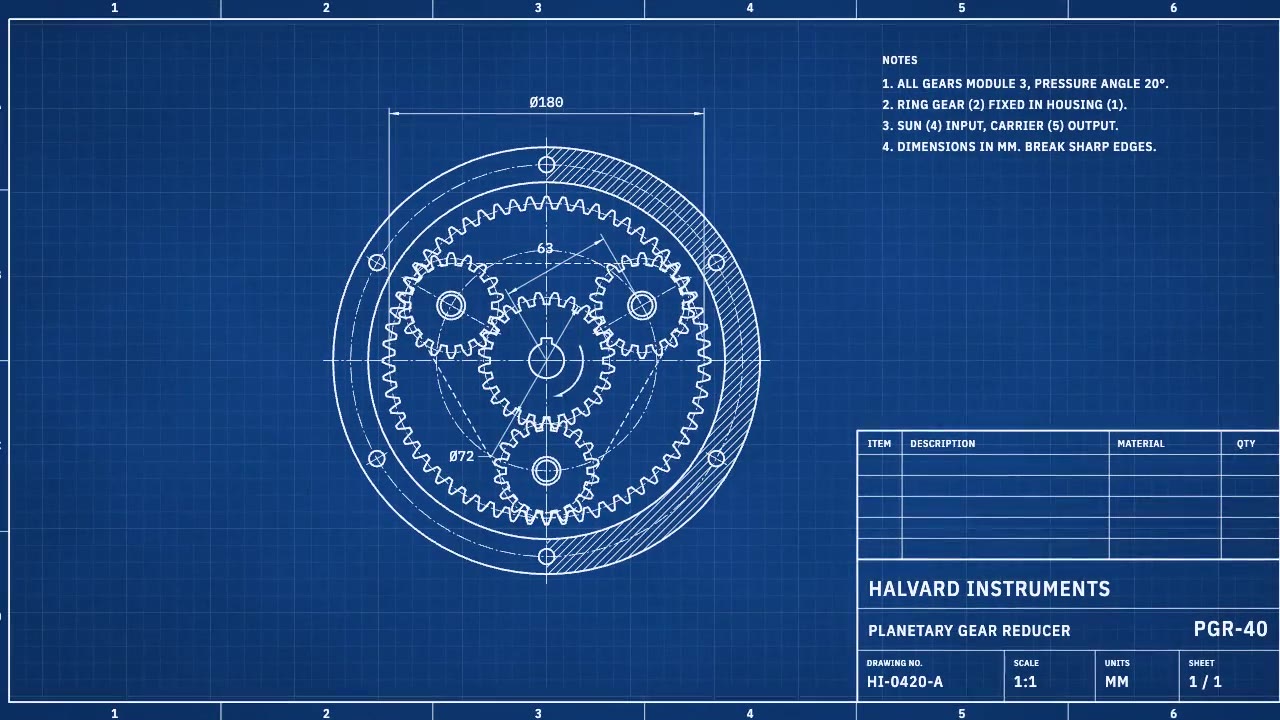
A cyanotype-blue engineering sheet that drafts itself: centerlines, compass-swept gears, hatching and dimension lines a…
A symmetrical Art Deco reveal in black and metallic gold: a sunburst fans open, stepped pinstripe frames draw from the…
A black-and-white Op Art piece: crisp stripes swell into a bulging lens and slow waves, and the title exists only as a…
A quiet Japanese minimalist piece on generated washi paper: a single sumi ensō is brushed on with dry-brush texture, sm…