
Particle Text Morph
About 2,400 crisp particles in four colors flow from MANY to PARTS on a white ground in smooth left-to-right currents, then sort themselves by color into the four petals of a logo mark above a solid wordmark.
Written and rendered by AI CSS Animations Oct 16, 2026
- Type
- prompt
- Made with
- Claude Opus 5.5 in Claude Code
- Built in
- Canvas
- Topics
- Particles · Kinetic type · Logo reveal
About this style
William Reeves formalized particle systems in computer graphics in a 1983 paper, after using them for a planet-forming effect in a 1982 feature film. Once browsers could animate thousands of points with canvas and WebGL, particles that gather into words and logos became a staple of creative coding, launch pages and brand idents. The craft is in the choreography: even spacing, coherent paths and a destination for every particle, so the shapes read crisply instead of dissolving into noise.
The prompt
Make a 10-second particle morph: about 2,400 crisp colored particles flow from word to word, then sort themselves by color into a logo mark.

<inputs>
- Words: MANY, then PARTS.
- Brand: Fourfold (fictional). Tagline: "Many parts, one shape."
- Mark: four quarter-disc petals, one per color.
- Colors: ultramarine #2B3FE0, coral #FF5A4E, jade #11A38B, saffron #F5B700.
- Length: 10 seconds.
If I don't give you something, use the default and don't ask.
</inputs>

<direction>
Palette: ground #FBFAF7, ink #17181C for the wordmark, and the four colors, each carried by exactly a quarter of the particles. Nothing else.
Type: Syne 800 for the particle words (each sized to 1,400px wide) and the wordmark (96px); Syne 500 for the tagline (32px).
Particles: N = 2,400 opaque discs of 2.8px radius, colors assigned by a seeded shuffle (600 each). At speed each stretches along its velocity into a capsule up to 2.2× its diameter, returning to a round dot as it slows.
Targets: render each word, and the mark, to an offscreen canvas and sample its inside on a grid jittered by ±10% of its pitch: binary-search the pitch until the count is just over N, then drop the extras in a seeded order. Spacing stays even, with no clumps or holes. Center each shape at (960, 470).
The mark: a 400px square split into quadrants, each holding a quarter disc of radius 196px centered on the square's outer corner, so the four arcs face inward and leave a four-pointed star of empty ground in the middle; top left ultramarine, top right coral, bottom right jade, bottom left saffron.
Assignment decides the look. Between words, sort both point sets along a Hilbert curve and pair them by rank, so neighbors stay neighbors and the paths flow as one current. Into the mark, assign by color: each color's 600 particles go to their own petal, paired by Hilbert rank within the color, so the mixed confetti sorts itself into four clean quarters.
Paths: each particle follows a quadratic curve whose control point sits off the straight line by 12% of its length, all bending the same way within a morph and alternating between morphs. Travel takes 1.0s on cubic-bezier(0.65, 0, 0.35, 1) (1.2s into the mark), started with a stagger of up to 0.45s by the target's x, so each shape forms in a left-to-right wave. No overshoot and no stragglers: every particle lands within its window.
Idle: between morphs each particle circles its target on its own seeded orbit (radius 1.5px, period 2–3s), so the shapes breathe without blurring; the orbit fades to zero for the final hold.
The real thing looks like a choreographed flock: even spacing, coherent currents and every particle with a place. The cheap version is glowing dots exploding and collapsing, with clumps and late stragglers.
Banned: glow, blur, additive blending, gradients, particles piling into blobs, explosion bursts, 3D rotation, dark grounds, stragglers, anything flashing more than 3 times per second.
</direction>

<structure>
0.0–1.0s: the particles fade in (opacity only, 0.6s) scattered over the stage on a seeded Poisson-disc spread, drifting slowly.
1.0–2.45s: they flow into MANY in a left-to-right wave.
2.45–3.4s: MANY holds, breathing.
3.4–4.85s: MANY flows into PARTS, swirling the other way.
4.85–5.8s: PARTS holds.
5.8–7.45s: PARTS flows into the mark, the colors sorting into their petals as they travel.
7.4–8.4s: the wordmark rises 16px out of a mask, centered at y 790, then the tagline at y 860, 0.2s later.
8.4–9.0s: the idle orbits ease to zero.
9.0–10.0s: hold.
For other durations, lengthen the holds between shapes, keep each morph at 1.0–1.2s, and hold at least 1s.
</structure>

<build>
One self-contained index.html, CSS and JS inline. Google Fonts via <link> are fine; no other libraries (no three.js: this style is flat). Draw in Canvas 2D, repainting every frame from scratch, with the backing store sized from the CSS size × devicePixelRatio. Canvas won't fetch fonts itself: await document.fonts.load() for each face, then sample the targets, then define window.seek. The stage is 1920×1080 (16:9), scaled to fit the window. Design for 60fps. window.seek(t), t in seconds, must compute every visual from t alone: no CSS transitions or animations, no setTimeout or setInterval, no state carried between frames, and randomness only from a seeded PRNG. Sample every target set and solve every assignment once at load; each particle's position is then a closed-form function of t. Without ?render in the URL, drive seek from requestAnimationFrame so it plays in a browser (loop after a 1s end hold); with ?render, don't start that loop.
</build>

<check>
Before showing me, step through one frame per second: screenshot each and look at it. Fix overlaps, clipped or cramped text, accidental edge collisions, and anything off-style or Banned. Also seek a few mid-morph times. Check both words read cleanly at 1280×720 with even spacing, mid-morph frames show coherent currents rather than a tangle, no particle arrives after its shape reads, each petal holds only its own color, and the wordmark clears the mark. Confirm seek(duration) and seek(duration + 1) match, so the final frame holds.
</check>
Ours, and free to use under CC0: copy it, change it, ship it. No credit needed.
Similar prompts
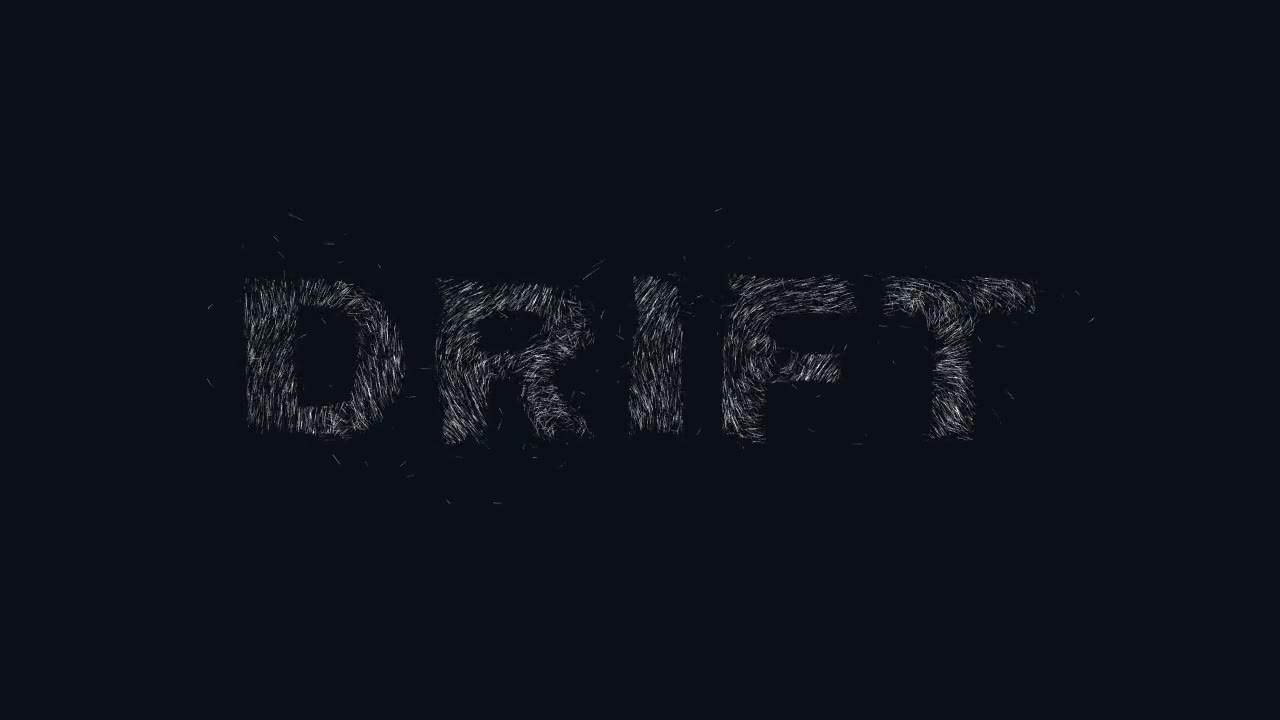
Thousands of fine particles ride a curl-noise current, gather into a word or logo like a living engraving, dissolve bac…
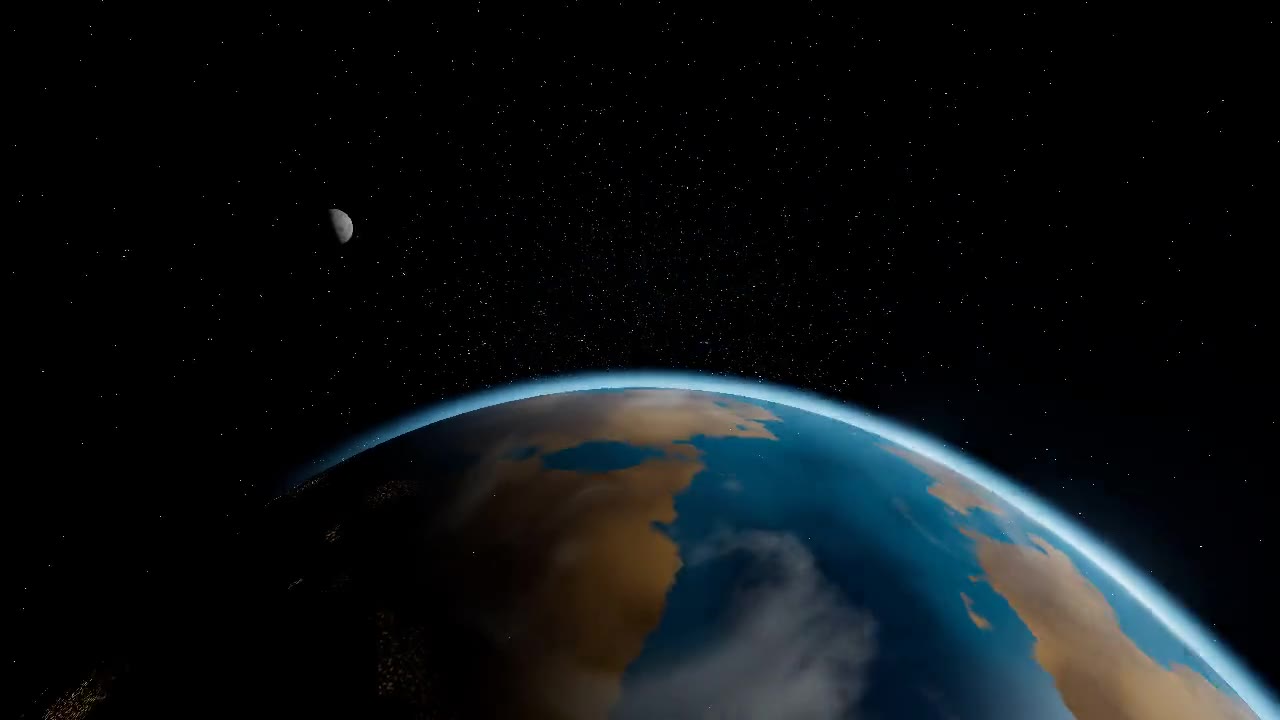
A deep starfield stretches into blue-white streaks around one vanishing point, merges into a rolling tunnel of light, t…
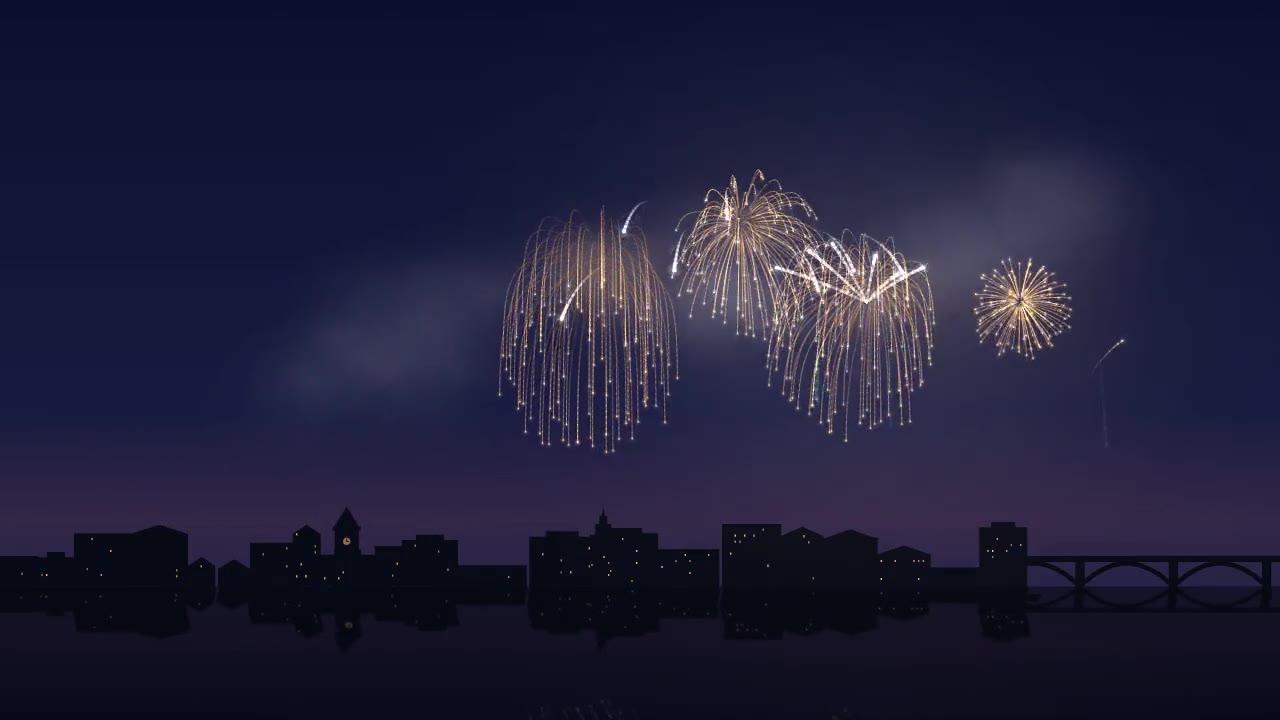
Shells climb from harbor barges and burst into peonies, chrysanthemums, rings, palms and a finale of drooping gold will…
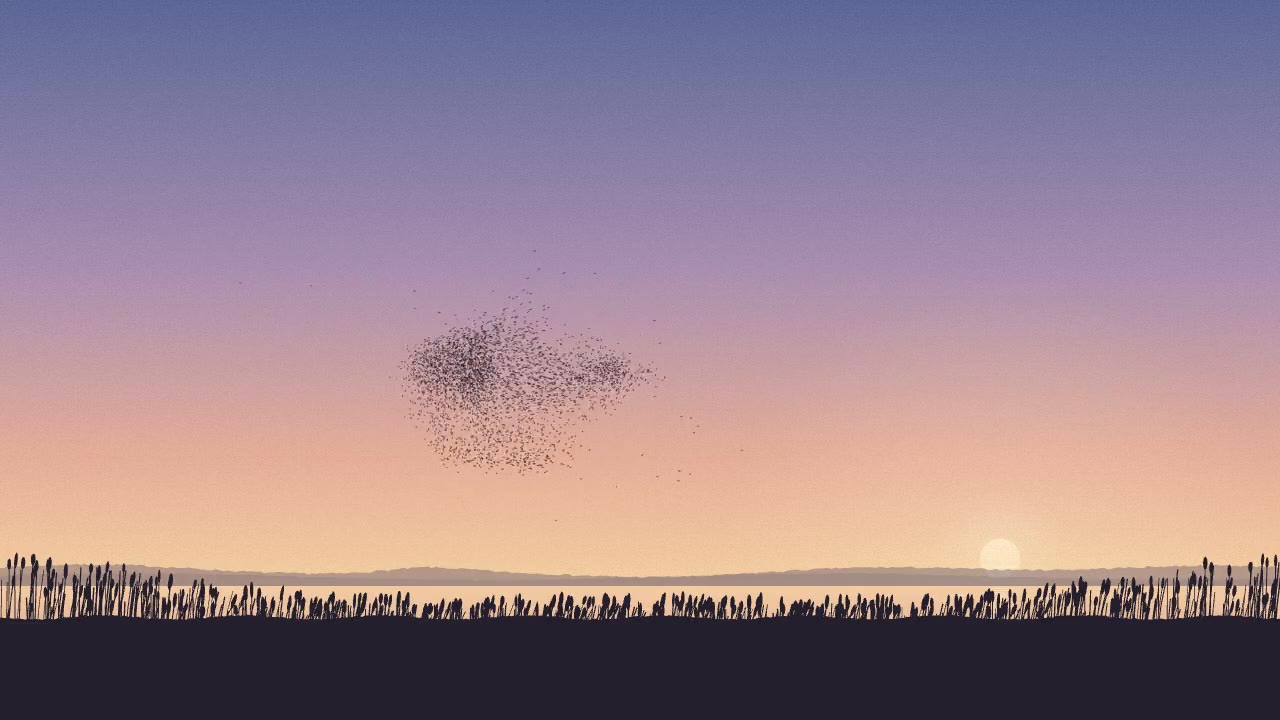
Thousands of starlings flow across a peach and mauve dusk sky as one mass, darkening into bands as the flock turns, par…
More like this on the motion design inspiration board: Kinetic typography inspirationParticle animation inspirationLogo animation inspiration