
Astronaut Drift
A tethered astronaut in a detailed white suit tumbles slowly beside a capsule high above a blue ocean planet, the gold visor sweeping with reflections, then pulls on the tether, steadies to face the camera and gives a slow, weightless wave as a quiet title fades in.
Written and rendered by AI CSS Animations Oct 18, 2026
- Type
- prompt
- Made with
- Claude Opus 5.5 in Claude Code
- Built in
- three.js
- Topics
- Characters · 3D
About this style
The first spacewalk was made by Alexei Leonov on 18 March 1965, tethered to his Voskhod 2 spacecraft. Suits built for work outside a spacecraft pair a hard upper torso, layered fabric limbs with bearing joints and a backpack life-support system, and their helmets carry a gold-coated visor that filters harsh sunlight. A tethered astronaut drifting above a blue planet has become one of the best-known images of space travel. Stylized astronauts are common in tech brand films, explainers and children's media.
The prompt
Make a 10-second 3D shot of an astronaut on a spacewalk: tethered to a capsule high above a sunlit planet, slowly tumbling, then steadying to wave at the camera.

<inputs>
If I don't give you something, use the default and don't ask.
- Mission: Arden 4, spacewalk 2 (fictional). Capsule lettering: ARDEN 4.
- Title: "Hello from orbit"
- Line: "Arden 4 · Spacewalk 2 · 412 km up"
- Clock: "EVA 01:12:04" at the start, counting up one second per second.
- Length: 10 seconds.
</inputs>

<direction>
- Look: a crisp, sunlit orbital photograph come to life: a hard white sun, black sky, a vivid blue planet and a suit that shows every seam. The astronaut is a character, with slightly stylized proportions (the helmet 15% larger than real) but built like the real thing.
- Palette: sky #02030A; ocean #2C7FC0 in full sun deepening to #123E6E toward the limb; clouds #F4F7FA; atmosphere rim #8CC8FF into #2C6FD6; suit white #EDEDE8 with fabric shade #B9BCC2; bearing rings #8C9096; gold visor #D7A84A; gloves #E5E3DC with grey palm pads #6A6E75; tether #F2F2EE with an orange tracer stripe #F08A3C; capsule panels #E9EAEC, heat-shield band #2A2C30, gold foil #C79A3E, handrails #E3B55A; text #FFFFFF, secondary #A9B6C8.
- Planet: a sphere of radius 60 below and ahead, its limb arcing from about y 720 at the left edge to y 600 at the right, the day side fully lit. One ShaderMaterial: ocean with a soft sun glint, a separate cloud shell from seeded 3D fBm in long swirled bands with two small cyclone spirals, turning 0.3°/s, and a back-face atmosphere shell with a Fresnel rim. Only open ocean and weather are in view: no coastlines, so no real geography.
- Capsule: behind the astronaut and to the right, about 700px tall on screen and cropped by the right edge: a truncated cone (base radius 2.2, top radius 0.9, height 3.0) with the dark heat-shield band at its base, overlapping white panels with recessed seams, rows of gold handrails on standoffs, four thruster quads, a docking ring at the top, a small window, an open side hatch (the door swung out on its hinges, warm light inside) and ARDEN 4 painted down one panel.
- Astronaut, about 560px tall on screen, centered near x 960, built with care:
  - helmet: a clear bubble shell (MeshPhysicalMaterial, transparent, low opacity, roughness 0.05) over a gold visor (metalness 1, roughness 0.06, #D7A84A) that reflects the planet; two helmet lamps and a small camera on the sides; a neck ring.
  - torso: a hard upper shell with a rectangular chest control box (dials, a toggle cluster, a small display) and a large backpack life-support unit with rounded edges, vents and two antenna stubs; a fictional mission patch (CanvasTexture) on the left shoulder.
  - limbs: soft fabric segments (capsules with low-frequency vertex noise for folds) joined by grey bearing rings at the shoulders, elbows, wrists, waist, knees and ankles; gloves with five capsule fingers and a wrist ring; boots with thick soles.
  - a safety tether from a waist ring to a handrail beside the hatch: a TubeGeometry (radius 0.03) rebuilt each seek along a slack curve between its ends, never taut, never kinked, never through the body.
- Weightless motion, with no gravity and no bounce: the astronaut tumbles slowly about a tilted axis (about 40°/s at first); a pull on the tether slows the spin, and the angular velocity decays on easeOutCubic to rest facing the camera by 6.2 s, so nothing snaps. Limbs drift on slow sines (4–7 s periods, ±8°); the body drifts within 0.6 units. The wave is slow and big: the right arm rises over 0.8 s, the hand swings ±25° three times at about 0.8 Hz, then holds open.
- Light: the sun as a DirectionalLight from the upper left, in front of the astronaut (intensity 3.0, #FFF8EE), with soft shadows (PCFSoftShadowMap, 2048) so the arms shade the torso and the capsule shades its own handrails; earthshine as a HemisphereLight (#0B0D12 over #5D8FCB, 0.8) so the suit's underside glows faintly blue; an environment map baked once with PMREMGenerator.fromScene from a small scene holding a bright sun card and a large blue lower hemisphere, so the visor shows the planet and the white fabric carries soft highlights. ACESFilmic, exposure 1.0, sRGB. Choose the tumble axis so the suit's lit side faces the camera at 0 s, through 6 s and at the end; the suit never reads grey.
- Camera: fov 35, about 9 units from the astronaut, with a slow 8° orbit and a 3% push-in across the piece on easeInOutSine.
- Type (HTML over the canvas): title in "IBM Plex Sans Condensed" 600, 72px, #FFFFFF, top-left at (120, 100); the line in "IBM Plex Mono" 500, 22px, uppercase, tracked 0.14em, #A9B6C8, beneath; the clock in IBM Plex Mono 500, 22px, #A9B6C8, under the line. All type sits on black sky.
- Premium: a suit with real hardware, a gold visor reflecting the planet, a hard sun with soft earthshine, and weightless motion that eases instead of bouncing. Cheap: a white capsule-shaped figure in a starfield, a glowing blue ball, a cartoon float on a sine.
Banned: starfields, lens flares, bloom, a visible face, a raised visor, real flags or space agency logos, real coastlines, the astronaut in shadow, sudden stops or bounces, the tether passing through the body or the capsule, anything flashing more than 3 times per second.
</direction>

<structure>
- 0.0–1.2s: the astronaut tumbling slowly and well lit, the tether curving back to the hatch; clouds turning below; the camera begins its orbit.
- 1.2–3.0s: the tumble continues through about half a turn; the planet's reflection sweeps across the gold visor.
- 3.0–5.0s: the left hand finds the tether and pulls gently; the spin slows and the body rights itself.
- 5.0–6.2s: steadied, upright and facing the camera, drifting; the visor holds the planet's limb as a bright curve. At 6.0 s the astronaut is upright, fully lit and facing the camera: a complete composition.
- 6.2–8.2s: the wave: the right arm rises and swings three times, then holds open.
- 7.4–8.4s: the title, line and clock fade in, rising 12px over 0.8 s on cubic-bezier(0.22, 1, 0.36, 1); the clock has been counting from the start.
- 8.4–10.0s: hold: the astronaut still with the hand raised; only the clouds turn.
For other lengths, stretch the tumble and keep at least 1 s of hold.
</structure>

<build>
- One self-contained index.html (inline CSS and JS), a 1920×1080 (16:9) stage scaled to fit the window, designed for 60fps. No image, video, texture or model files: every shape and texture is generated in code.
- window.seek(t), t in seconds, computes every visual from t alone: no CSS transitions or CSS animations, no setTimeout/setInterval, no state carried between frames, randomness only from a seeded PRNG. Anything cumulative is solved analytically from t or precomputed once at load at a fixed step. Past the end, seek clamps to the last frame.
- Without ?render in the URL, drive seek from requestAnimationFrame so it plays in a browser (loop after a 1s end hold); with ?render, don't start that loop.
- Google Fonts via <link> are fine; await document.fonts.load() for each face before defining window.seek.
- Engine: three.js as an ES module pinned to three@0.160.0 through an import map on jsDelivr (`three` and `three/addons/`). WebGLRenderer with antialias, preserveDrawingBuffer: true and setPixelRatio(window.devicePixelRatio); render once at the end of every seek. Text is HTML over the canvas.
- Every rotation, drift, limb angle, tether curve and cloud angle is a closed-form function of t; the tether tube is rebuilt from that curve each seek and the environment map is baked once at load.
</build>

<check>
Before showing me, step through one frame per second (t = 0…10): screenshot each and look at it. Fix overlaps, clipped or cramped text, and anything off-style or Banned. Check the suit's lit side reads near-white in every frame with clear shading and no dark seconds, the visor reflects the planet, the tether stays slack and outside the body, the planet shows no coastlines, the spin eases to rest without a snap, and the type sits on black sky clear of the astronaut. Confirm seek(10) and seek(11) match, so the final frame holds.
</check>
Ours, and free to use under CC0: copy it, change it, ship it. No credit needed.
Similar prompts
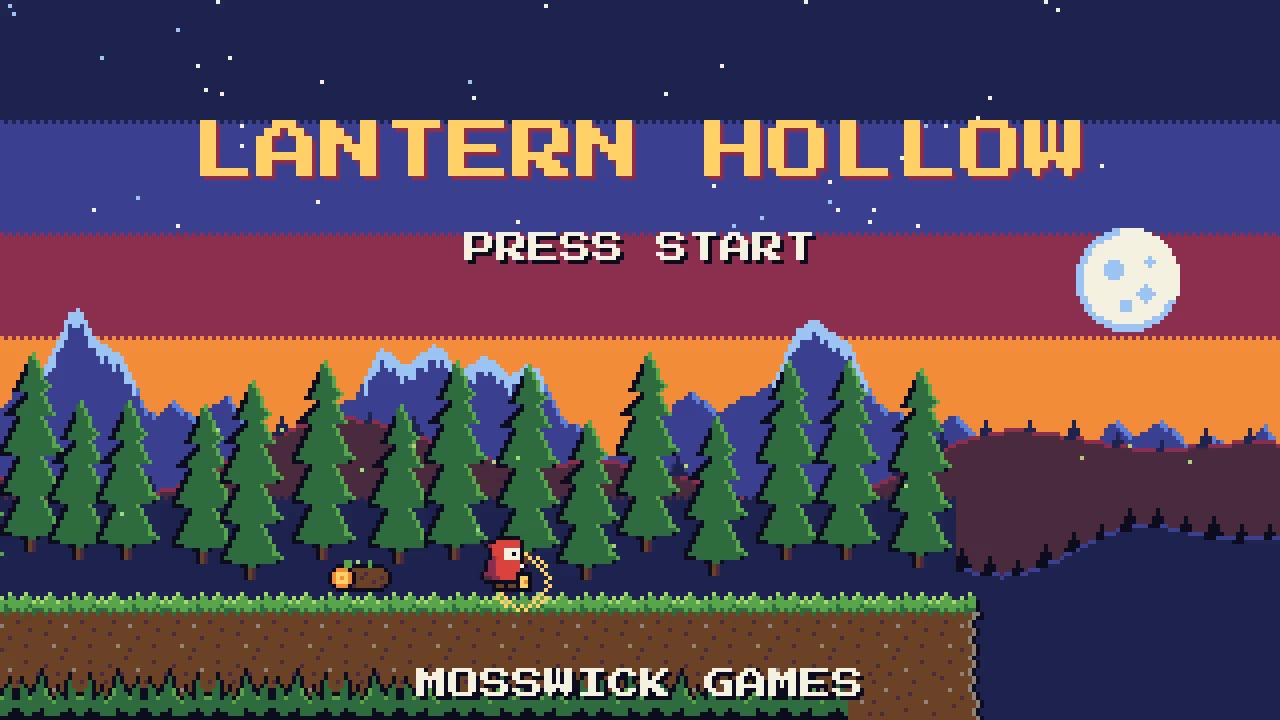
An 8-bit attract screen: a dusk forest scrolls in parallax layers as a tiny lantern-carrying hero walks, hops a log and…
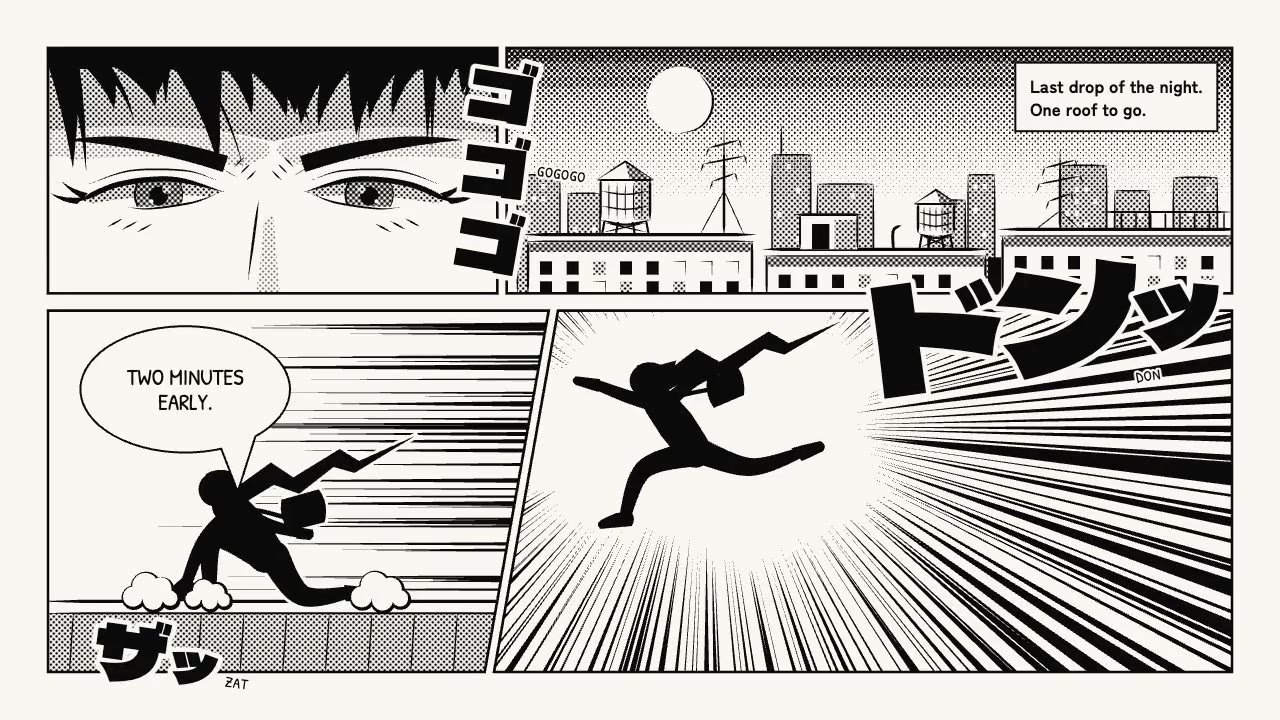
A black-and-white manga page read right to left: rooftops, narrowed eyes, a silhouetted courier leaping through focus l…
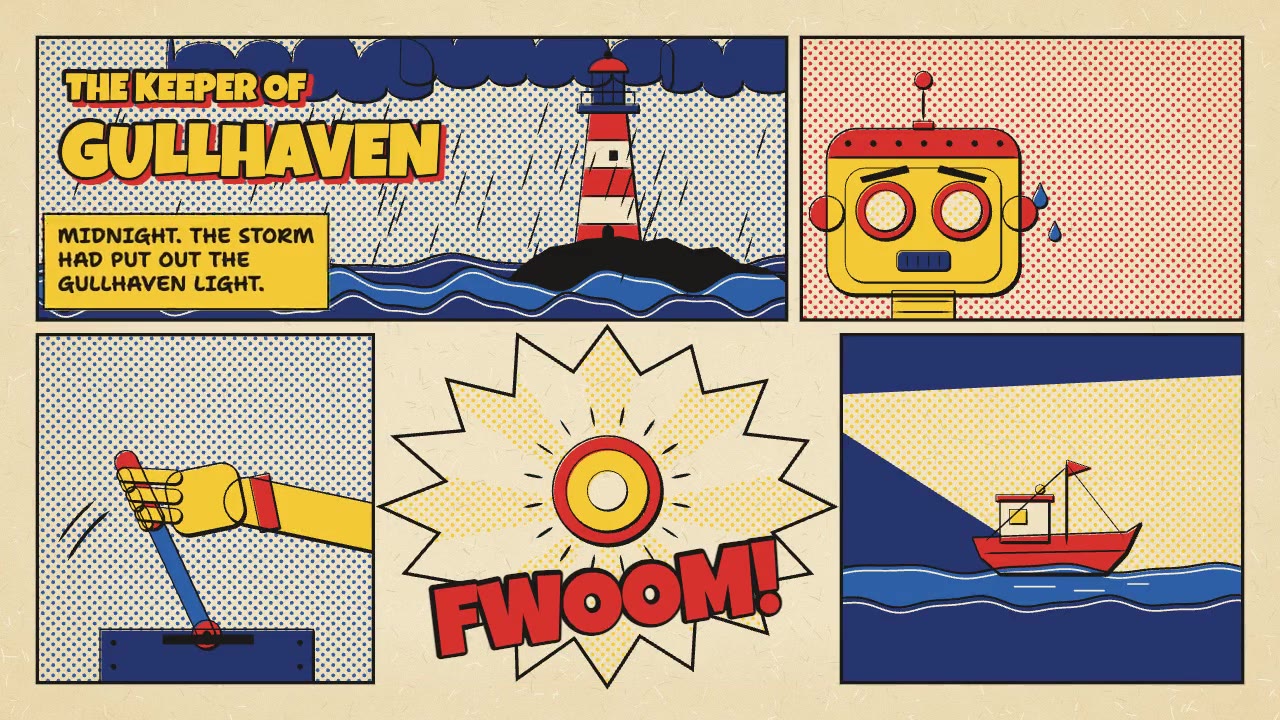
A five-panel comic page made the old way: blue pencil roughs, weighted black inks, flat process color with Ben-Day dots…
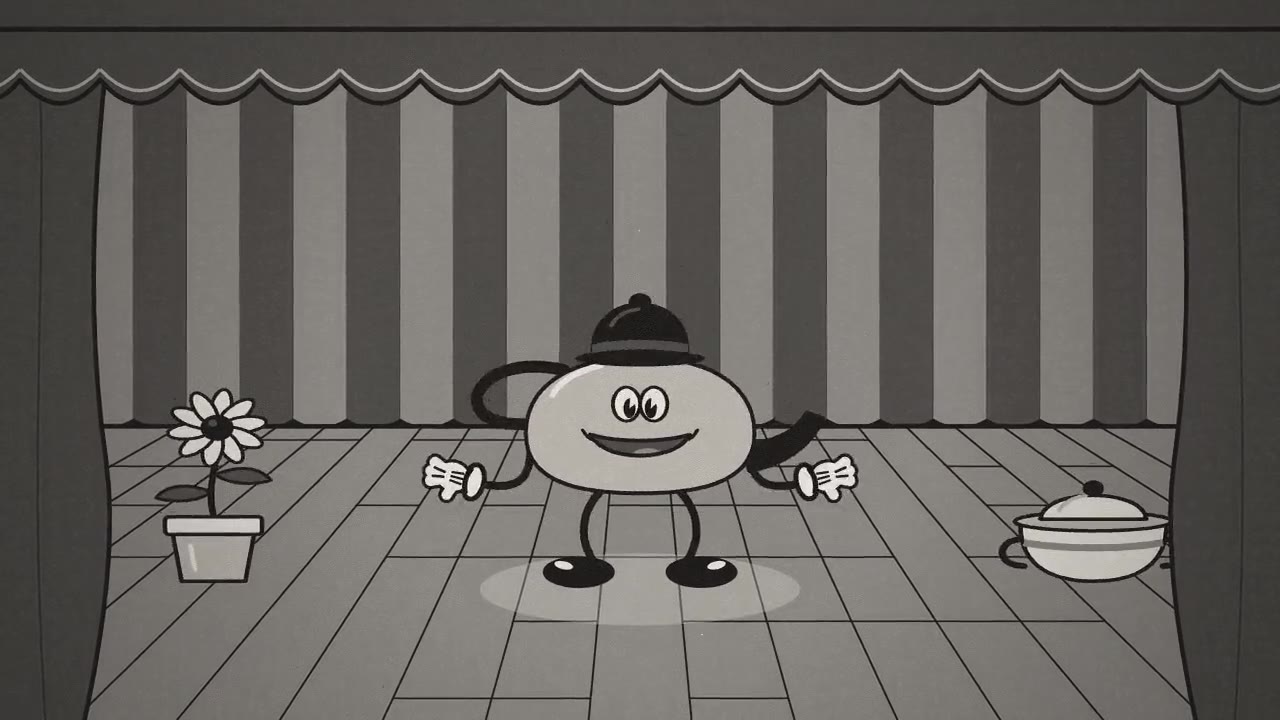
A black-and-white 1930s cartoon: Tippy, an original teakettle with rubber-hose limbs, white gloves and pie-cut eyes, da…
More like this on the motion design inspiration board: 3D motion design inspirationCharacter animation inspiration