
One-Bit Dithered Desktop
A strictly two-color retro desktop at chunky 4× pixels: a cursor opens a window, a Bayer-dithered sphere turns under moving light, a patterned progress bar fills and a crisp pixel-type dialog lands.
Written and rendered by AI CSS Animations Oct 12, 2026
- Type
- prompt
- Made with
- Claude Opus 5.5 in Claude Code
- Built in
- Canvas
- Topics
- Product UI · Shapes
About this style
Early personal computers with monochrome displays, the original Macintosh among them, could only switch each pixel on or off, so designers built grey, shading and texture from dither patterns. Ordered dithering, typically with the Bayer matrix named for Bryce Bayer, thresholds tone against a fixed grid and produces regular crosshatch-like textures rather than noise. Designers revive the look for its crisp, characterful texture and its honesty about the pixel.
The prompt
<inputs>
If I don't give you something, use the default and don't ask.
- Product name: default "LOWBIT"
- Version: default "1.0"
- Tagline: default "Less color. More character."
- Ink and paper: default #000000 / #FFFFFF (any two-color pair works)
- Length: default 10 seconds
</inputs>

<direction>
An early monochrome desktop, shown with love: every pixel ink or paper, tone made from pattern, interface built from 1 px lines.

Pixels: draw everything on an offscreen 480×270 canvas, then blit to the stage at exactly 4× with image smoothing off. Every output pixel is one of the two colors: no grey, no anti-aliasing, no alpha.

Dithering: compute tone (shading, gradients, shadows) per pixel, then threshold it against an 8×8 Bayer matrix locked to screen coordinates, so when light moves the pattern crawls across surfaces instead of travelling with them. That crawl is the signature.

Type: Silkscreen (Google Fonts) drawn on the low-res canvas at 8 px (16 for headings, 24 for the hero), hard-thresholded at 50% so glyphs are pure pixels.

UI: a 50% checker desktop; a menu bar with a 1 px rule; windows with a 1 px border, 1 px offset shadow and a title bar of six horizontal stripes with the title on a knocked-out plate; buttons, the default with a thick ring; an arrow cursor sprite. Invent your own icons; no real OS logos.

Motion: positions round to whole low-res pixels, so motion is stepped and crisp. Cursor legs take 0.6–0.9 s, easeInOutQuad. Windows open with zoom rectangles: 5 outlines expanding from the icon over 0.3 s. Pressed controls invert while held. Light orbits take at least 3 s. The dialog stays up at least 2 s.

Authentic: screen-locked patterns and exact 1 px rules; cheap: anti-aliased type and noisy dither.

Banned: blur, glow, smoothed scaling, error-diffusion dither that boils, scanlines, CRT curvature, more than one full-screen inversion, blinking more than 3 times per second.
</direction>

<structure>
Default 10 s:
- 0.0–0.8: white screen; the checker desktop fills downward in 8-pixel bands.
- 0.8–1.4: menu bar and a desktop icon named for the product snap in.
- 1.4–3.0: the cursor travels to the icon, which inverts on arrival; a double-click at 2.8 opens it.
- 3.0–3.3: zoom rectangles expand to the window bounds.
- 3.3–6.2: the window shows a big Bayer-shaded sphere with a cast shadow, light orbiting so the pattern crawls.
- 6.2–7.4: a progress bar fills in steps (25%, 50%, solid), labelled "RENDERING 1-BIT…".
- 7.4–8.0: a double-bordered dialog pops center: name and version at 24 px, tagline at 8 px, an OK button.
- 8.0–10.0: the cursor glides to OK and rests; still from 8.8.

Other lengths: scale the holds, keep cursor timing.
</structure>

<build>
- One self-contained index.html, no libraries (three.js from a CDN only when a style truly needs 3D); a 1920×1080 (16:9) stage scaled to fit the window; designed for 60fps.
- window.seek(t), t in seconds, computes every visual from t alone: no CSS transitions or animations, no setTimeout/setInterval, no state carried between frames. Any randomness comes from a seeded PRNG keyed to the frame.
- No ?render in the URL: drive seek from requestAnimationFrame so it plays in a browser. With ?render: don't start that loop.
- Google Fonts via <link>; await document.fonts.load() for each face before assigning window.seek.
- Canvas 2D only.
</build>

<check>
Before showing me, step through one frame per second and look at each. Fix overlaps, clipped or cramped text and anything off-style. Sample pixels to prove only two colors exist. Confirm the final frame holds.
</check>
Ours, and free to use under CC0: copy it, change it, ship it. No credit needed.
Similar prompts

A slow, ribbon-like gradient mesh flows in a skewed band behind sharp headline type, while white payment, API and chart…
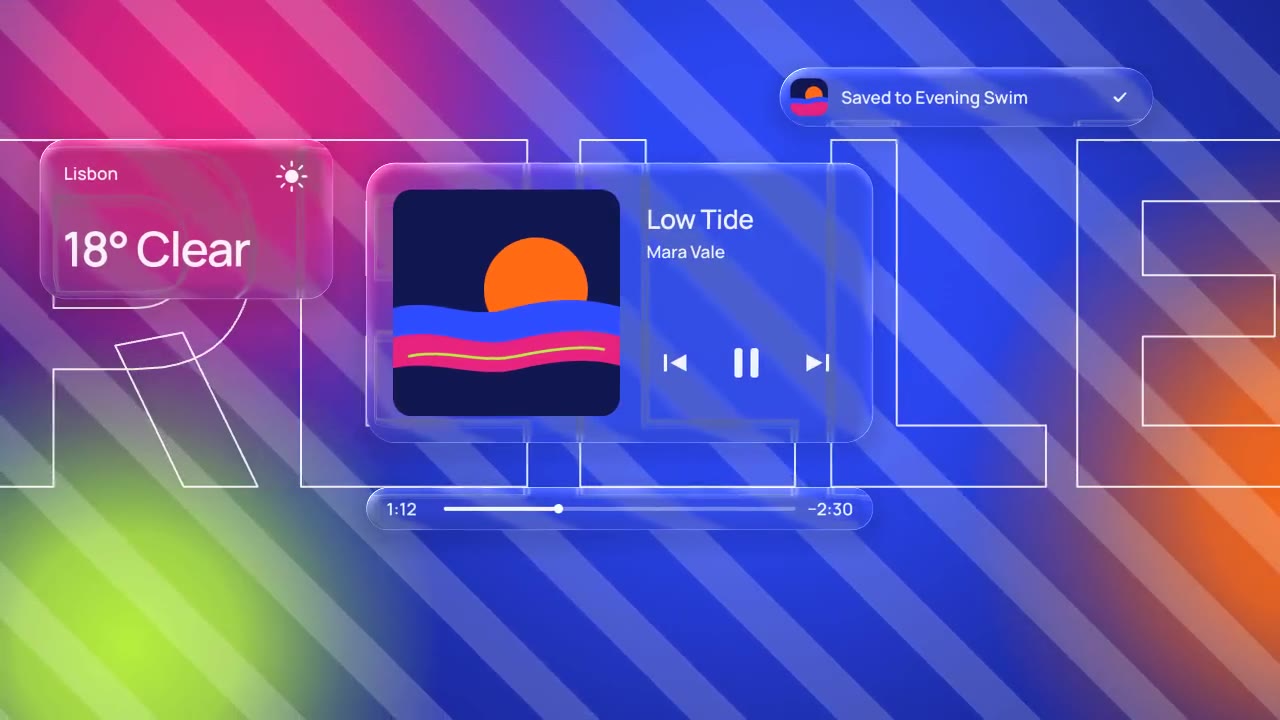
Glass panels with real refraction float over vivid, striped color: their rims bend what's behind them, two buttons fuse…
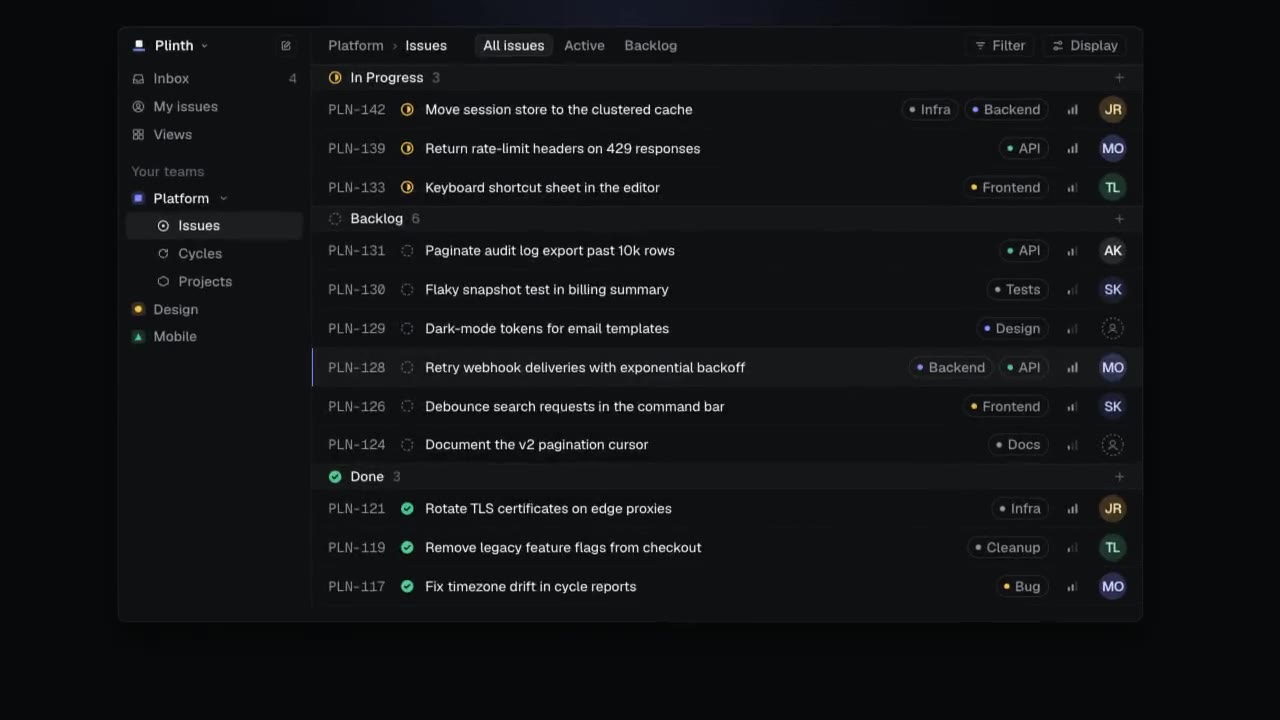
A dark-mode work tool drawn in hairlines and quiet radial glows: issue rows populate, ⌘K opens a command menu, a comman…
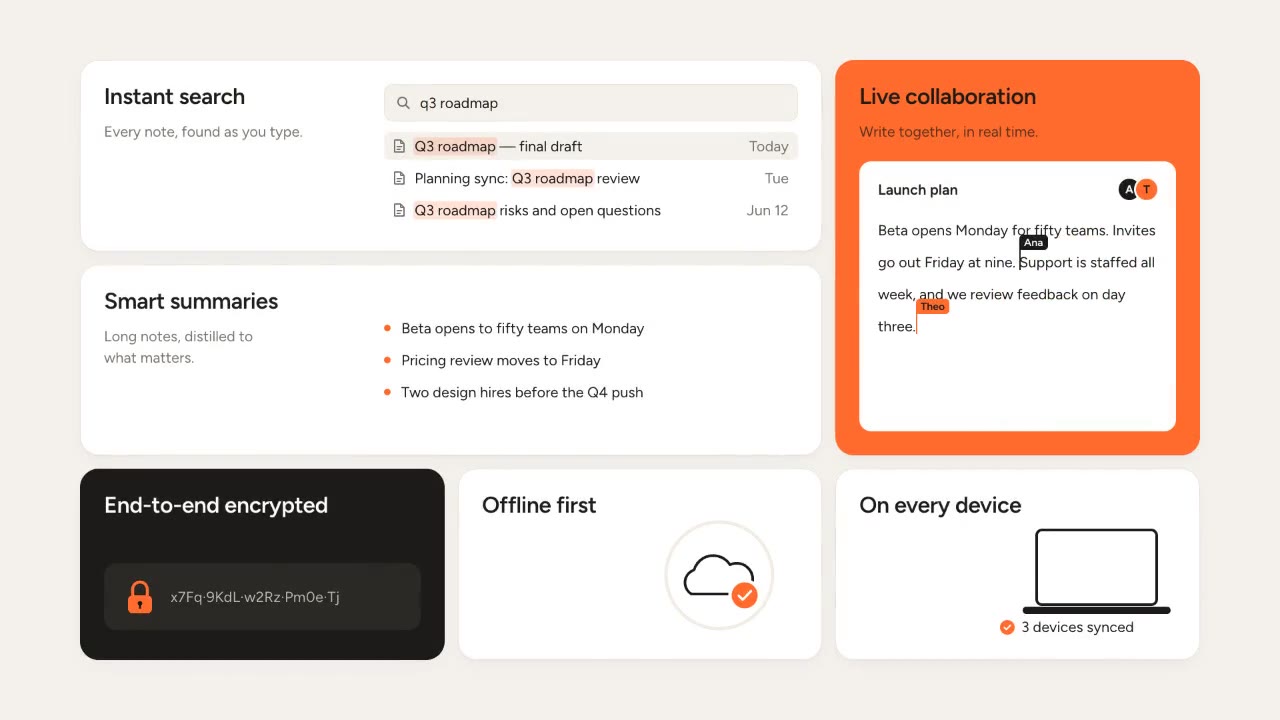
Rounded tiles spring into a bento grid on warm paper, each acting out one feature in a small animation, then the tiles…