
Multiplayer Design Canvas
A light design-tool canvas where three people work at once: a pink cursor draws a new frame, an amber one rewrites a headline, a comment pin drops on a button, and your own pointer widens it by 8px while the layers list and properties panel update live.
Written and rendered by AI CSS Animations Oct 16, 2026
- Type
- prompt
- Made with
- Claude Opus 5.5 in Claude Code
- Built in
- HTML/CSS
- Topics
- Product UI
About this style
Browser-based design tools made real-time collaboration visible: each collaborator's cursor appears on the shared canvas with a name tag in their own color. Frames, selection handles, a layers panel and comments pinned to the design are the core vocabulary of these canvases. Product films show several people working at once, because simultaneous editing that never collides is the feature itself.
The prompt
Make a 10-second multiplayer design canvas demo: three people work in one file at once, their named cursors drawing a frame, editing text and pinning a comment, while selection handles and the layer list update live.

<inputs>
If I don't give you something, use the default and don't ask.
- Tool: Tracery. File: "Onboarding v3"
- You: Ilse (black pointer, selection #5B5BF0). Collaborators: Noor #F2557A, Kofi #F5A524
- Frame "Onboarding / 01": hero art, title "Plan trips together", body "Shared lists, one calendar.", a 280×56 "Get started" button
- Edits: Kofi retitles it "Plan your week together"; Noor draws "Onboarding / 02" and comments "Can the button be 8px wider?"; you widen it to 288 and reply "Done, 288 now."
- Length: 10 seconds
</inputs>

<direction>
Palette: stage #DAD7CF; chrome #FFFFFF; canvas #F3F2EE with a 24px dot grid; ink #1D1D1F; secondary #6F6E73. The design has its own palette: white frames, a #EDE7FF hero with three overlapping circles, a #5B5BF0 button.
Type: Schibsted Grotesk 400–600 for the tool at 20–22px; the design uses Gabarito (title 34px/700, body 22px), so the work reads apart from the chrome.
Layout: a 1776×936 window at (72, 72): a 56px toolbar (drawn tools, file name, three avatars ringed in their colors), a 280px layers panel, a 300px properties panel, the canvas between. Frame 01 is 360×640, 80px in from the canvas's top-left; the new frame lands 80px to its right.
Remote cursors: an arrow in the person's color with a white outline and a 20px name pill beside it (ink text on amber). They move like hands: curved paths at uneven speeds (0.4–0.9s on cubic-bezier(0.4, 0, 0.2, 1)) and a small seeded idle wander that fades out by 8.6s. Yours is a plain black arrow.
Selections: a 1.5px box in the owner's color with eight white handles and a size chip; remote boxes carry the owner's name. Edited text shows a caret and a 25% highlight in the editor's color. Frame drags show a live "W × H" chip and snap to 8px.
Panels: layers (Onboarding / 01 with Hero, Title, Body, Button) dot each row in the color of whoever is touching it, slide new rows in and rename text layers as they change; properties show your selection (W, H, X, Y, fill, radius), values rolling as they change.
Comments: a round pin in Noor's color drops on a spring and opens a 300px thread card beside it, never over frame 01's content.
Actions overlap but stay legible: starts at least 0.3s apart; cursors and tags never cross.
Premium is collaboration you can follow: three hands with distinct habits, every action echoed in the panels. Cheap is colored arrows drifting over a static mockup.
Banned: real design-tool names or copies of their UI, anonymous or teleporting cursors, overlapping tags, emoji, anything flashing more than 3 times per second.
</direction>

<structure>
0.0–0.9s: the window rises 24px and fades in on frame 01; the toolbar avatars pop in 80ms apart.
0.9–2.8s: Noor enters from the right and drags out the new frame, the chip counting to "360 × 640"; it becomes "Onboarding / 02" and its row slides in with her dot.
1.4–4.2s: Kofi double-clicks the title (an amber box with his name), selects "trips" and types "your week" at about 10 characters a second; the layer renames; he clicks away.
3.6–5.0s: Noor drops the pin on the button's top-right corner; her thread opens.
5.0–6.8s: your pointer selects the button (indigo handles, "280 × 56") and drags the right handle 8px; chip and W roll to 288.
6.8–8.0s: your reply types into the thread and posts; the pin gains a check.
8.0–8.6s: the cursors settle clear of the content.
8.6–10.0s: hold, perfectly still.
For other lengths, scale the beats but keep typing speeds fixed and hold at least 1s.
</structure>

<build>
One self-contained index.html, CSS and JS inline; Google Fonts via <link>, awaited with document.fonts.load() before window.seek is defined; no other libraries. Use HTML/CSS with inline SVG for cursors, handles, pins and icons; each person's moves and actions are a timeline built once at load and read by t. The stage is 1920×1080 (16:9), scaled to fit the window; design for 60fps. window.seek(t), t in seconds, must compute every visual from t alone: no CSS transitions or animations, no setTimeout or setInterval, no state carried between frames, randomness only from a seeded PRNG. Without ?render in the URL, drive seek from requestAnimationFrame (loop after a 1s end hold); with ?render, don't start that loop.
</build>

<check>
Before showing me, step through one frame per second: screenshot each and look at it. Fix overlaps, clipped or cramped text and anything off-style or Banned. Check tags never overlap each other or edited text, the panels always agree with the canvas (new frame listed, title renamed, W 288 at the end), and both frames sit on the 8px grid. Confirm seek(10) and seek(11) match, so the final frame holds.
</check>
Ours, and free to use under CC0: copy it, change it, ship it. No credit needed.
Similar prompts

A slow, ribbon-like gradient mesh flows in a skewed band behind sharp headline type, while white payment, API and chart…
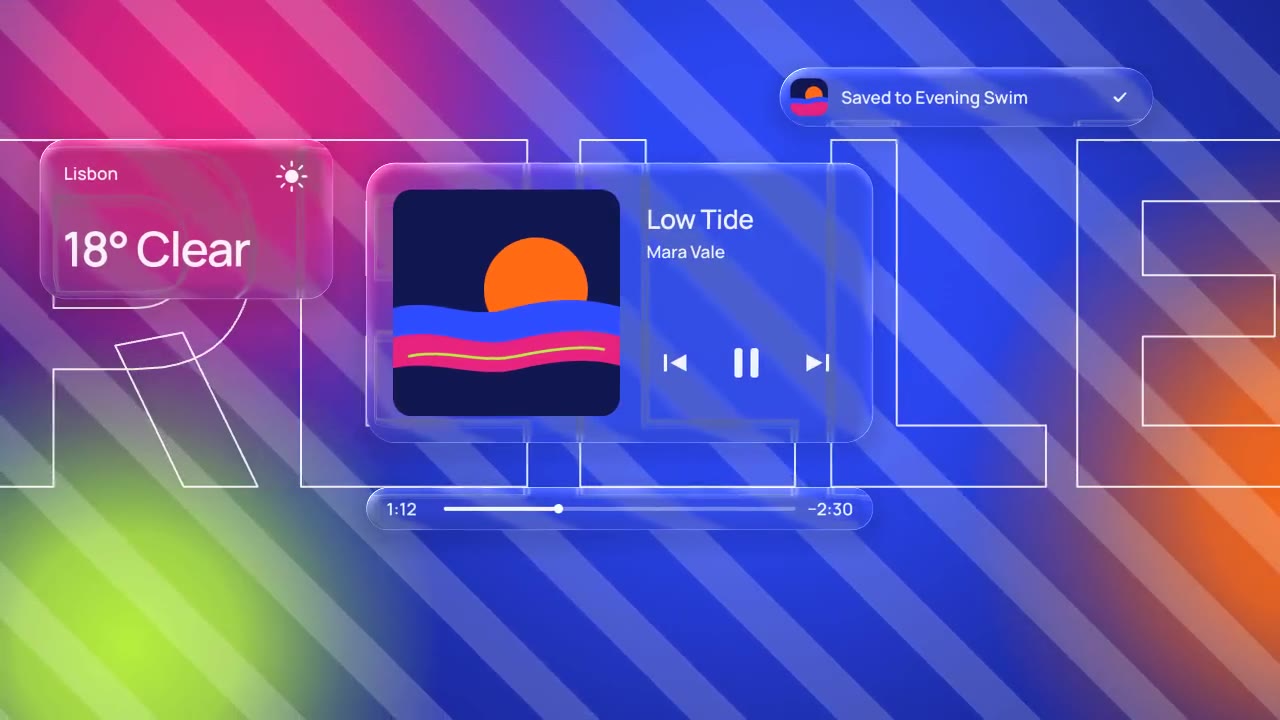
Glass panels with real refraction float over vivid, striped color: their rims bend what's behind them, two buttons fuse…
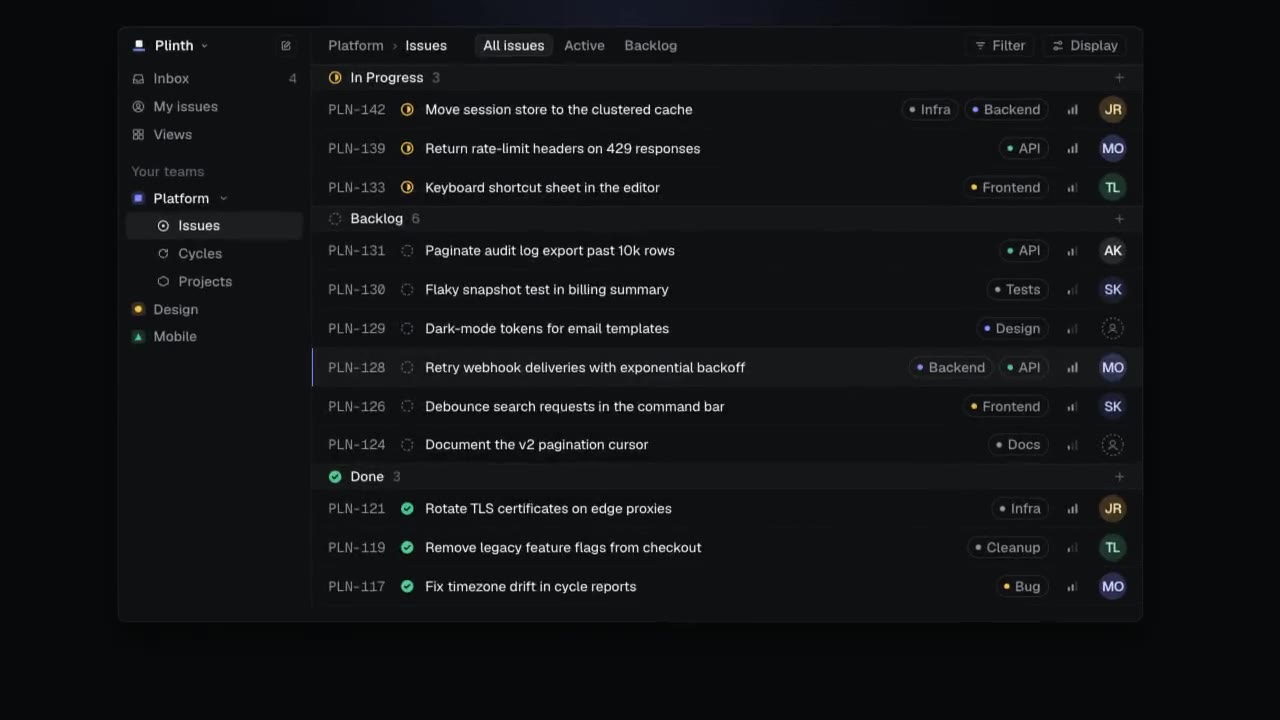
A dark-mode work tool drawn in hairlines and quiet radial glows: issue rows populate, ⌘K opens a command menu, a comman…
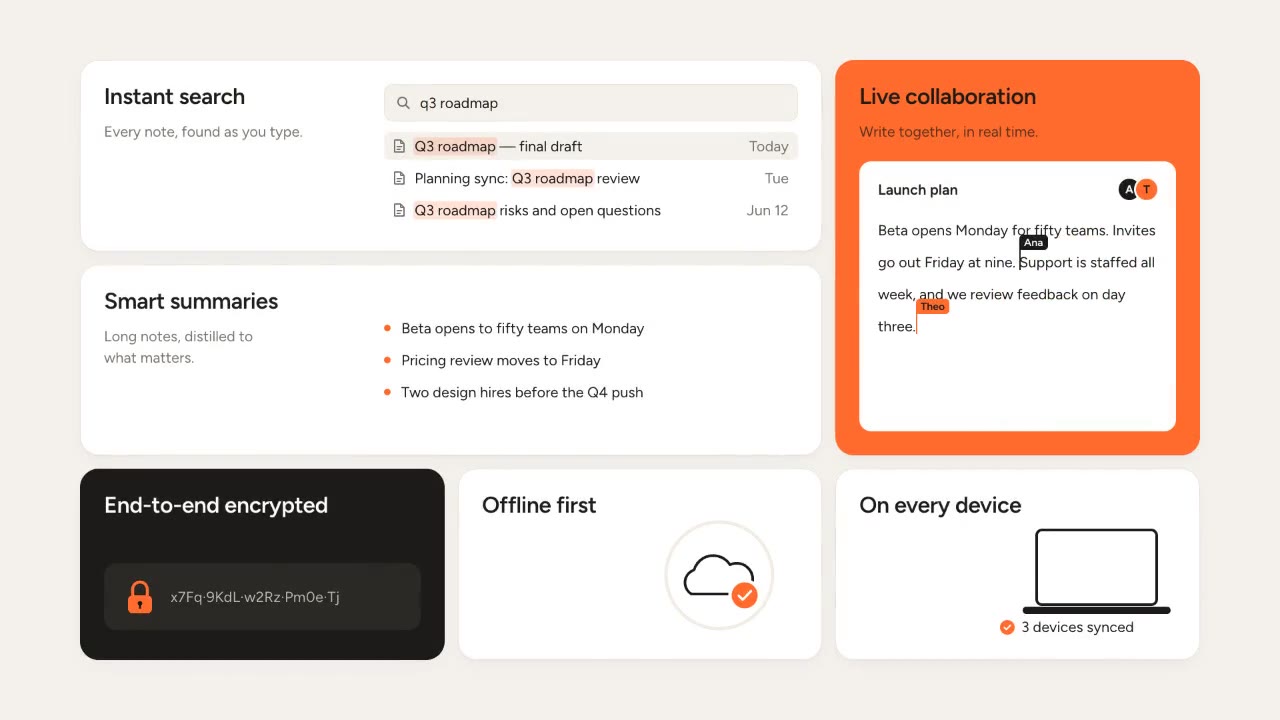
Rounded tiles spring into a bento grid on warm paper, each acting out one feature in a small animation, then the tiles…
More like this on the motion design inspiration board: UI animation inspiration